Ch.5 - Stereochemistry
Wade - Organic Chemistry 9th Edition
Wade9th EditionOrganic ChemistryISBN: 9780135213728Not the one you use?Change textbook
Chapter 5, Problem 2e,f

Make a model and draw a three-dimensional structure for each compound. Then draw the mirror image of your original structure and determine whether the mirror image is the same compound. Label each structure as being chiral or achiral, and label pairs of enantiomers.
(e)
(f)

Verified step by step guidance
1
Step 1: Analyze the given structure. The compound shown is a bicyclic ketone. Identify the stereocenters in the molecule by looking for carbon atoms attached to four different groups.
Step 2: Build a three-dimensional model of the compound using molecular modeling software or physical model kits. Pay attention to the spatial arrangement of substituents around stereocenters.
Step 3: Draw the three-dimensional structure of the compound, ensuring that the perspective (wedge and dash bonds) accurately represents the spatial arrangement of atoms.
Step 4: Draw the mirror image of the original structure. Ensure that the mirror image reflects the spatial arrangement of the original structure accurately.
Step 5: Compare the original structure and its mirror image. Determine if they are superimposable (identical) or non-superimposable. Label the original structure and its mirror image as chiral or achiral based on this comparison. If they are non-superimposable, label them as enantiomers.

Verified video answer for a similar problem:

This video solution was recommended by our tutors as helpful for the problem above.
Video duration:
7m
Was this helpful?

Key Concepts

Here are the essential concepts you must grasp in order to answer the question correctly.

Chirality

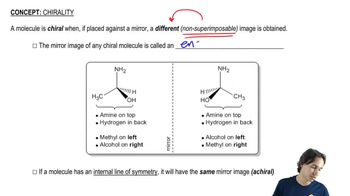
Chirality refers to the geometric property of a molecule that makes it non-superimposable on its mirror image. A chiral molecule typically has a carbon atom bonded to four different substituents, resulting in two distinct forms known as enantiomers. These enantiomers can exhibit different optical activities, meaning they rotate plane-polarized light in opposite directions.
Recommended video:
Guided course
05:10
What is chirality?

Enantiomers

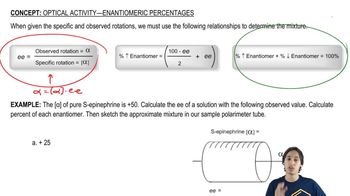
Enantiomers are a specific type of stereoisomer that are mirror images of each other but cannot be superimposed. They have identical physical properties in a symmetrical environment but can behave differently in chiral environments, such as biological systems. Identifying enantiomers is crucial in organic chemistry, especially in pharmaceuticals, where the activity of a drug can depend on its specific enantiomer.
Recommended video:
Guided course
03:23
How to solve for the percentage of each enantiomer.

Achirality

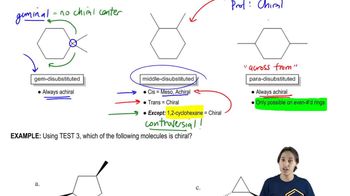
Achirality describes molecules that are superimposable on their mirror images, meaning they do not have a chiral center. These molecules can have symmetrical structures, such as those with a plane of symmetry. Understanding achirality is important for distinguishing between chiral and achiral compounds, as it helps in predicting the behavior of substances in chemical reactions and interactions.
Recommended video:
Guided course
04:48
Cis-1,2-Disubstituted Cyclohexane:A controversial exception.
Related Practice
Textbook Question

Determine whether the following objects are chiral or achiral.

1100
views

Textbook Question

Make a model and draw a three-dimensional structure for each compound. Then draw the mirror image of your original structure and determine whether the mirror image is the same compound. Label each structure as being chiral or achiral, and label pairs of enantiomers.

(c) cis- and trans-1,3-dimethylcyclobutane

(d) 2-bromobutane

1673
views
Textbook Question

Draw a three-dimensional structure for each compound, and star all asymmetric carbon atoms. Draw the mirror for each structure, and state whether you have drawn a pair of enantiomers or just the same molecule twice. Build molecular models of any of these examples that seem difficult to you.

(i)

943
views
Textbook Question

Draw a three-dimensional structure for each compound, and star all asymmetric carbon atoms. Draw the mirror for each structure, and state whether you have drawn a pair of enantiomers or just the same molecule twice. Build molecular models of any of these examples that seem difficult to you.

(c)

(d) 1-bromo-2-methylbutane

2572
views
Textbook Question

Draw a three-dimensional structure for each compound, and star all asymmetric carbon atoms. Draw the mirror for each structure, and state whether you have drawn a pair of enantiomers or just the same molecule twice. Build molecular models of any of these examples that seem difficult to you

(a)

(b)

2005
views
Textbook Question

Make a model and draw a three-dimensional structure for each compound. Then draw the mirror image of your original structure and determine whether the mirror image is the same compound. Label each structure as being chiral or achiral, and label pairs of enantiomers.

(a) cis-1,2-dimethylcyclobutane

(b) trans-1,2-dimethylcyclobutane

1507
views