
Textbook Question
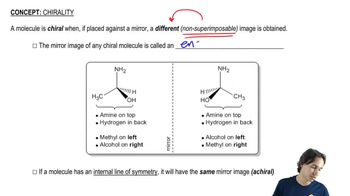
Determine whether the following objects are chiral or achiral.
1100
views



 Verified step by step guidance
 05:10
05:10
 03:23
03:23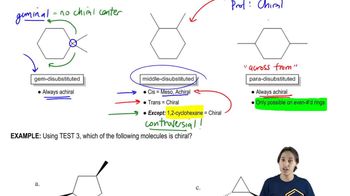 04:48
04:48Determine whether the following objects are chiral or achiral.
Make a model and draw a three-dimensional structure for each compound. Then draw the mirror image of your original structure and determine whether the mirror image is the same compound. Label each structure as being chiral or achiral, and label pairs of enantiomers.
(c) cis- and trans-1,3-dimethylcyclobutane
(d) 2-bromobutane
Draw a three-dimensional structure for each compound, and star all asymmetric carbon atoms. Draw the mirror for each structure, and state whether you have drawn a pair of enantiomers or just the same molecule twice. Build molecular models of any of these examples that seem difficult to you.
(i)
Draw a three-dimensional structure for each compound, and star all asymmetric carbon atoms. Draw the mirror for each structure, and state whether you have drawn a pair of enantiomers or just the same molecule twice. Build molecular models of any of these examples that seem difficult to you.
(c)
(d) 1-bromo-2-methylbutane
Draw a three-dimensional structure for each compound, and star all asymmetric carbon atoms. Draw the mirror for each structure, and state whether you have drawn a pair of enantiomers or just the same molecule twice. Build molecular models of any of these examples that seem difficult to you
(a)
(b)
Make a model and draw a three-dimensional structure for each compound. Then draw the mirror image of your original structure and determine whether the mirror image is the same compound. Label each structure as being chiral or achiral, and label pairs of enantiomers.
(a) cis-1,2-dimethylcyclobutane
(b) trans-1,2-dimethylcyclobutane