Ch. 9 - Alkenes II: Oxidation and Reduction
Mullins - Organic Chemistry: A Learner Centered Approach 1st Edition
Mullins1st EditionOrganic Chemistry: A Learner Centered ApproachISBN: 9780137566471Not the one you use?Change textbook
Chapter 8, Problem 21

When using a terminal alkene under the conditions shown here, explain why it is unnecessary to show the relative stereochemical outcome in the product.
Chemical reaction diagram showing dihydroxylation of a terminal alkene with OsO4 and NaHSO3, yielding a product with two hydroxyl groups.

Verified step by step guidance
1
Understand the nature of a terminal alkene: A terminal alkene is an alkene where the double bond is located at the end of the carbon chain. This means one of the carbons in the double bond is bonded to only one other carbon atom, while the other is bonded to two hydrogens.
Recognize the stereochemical implications: In a terminal alkene, the double bond involves a carbon atom that is bonded to two identical hydrogen atoms. This symmetry eliminates the possibility of stereochemical variation at this carbon.
Consider the reaction conditions: Many reactions involving alkenes, such as addition reactions, can lead to stereochemical outcomes. However, in the case of a terminal alkene, the symmetry of the molecule ensures that any stereochemical differences in the product are irrelevant or nonexistent.
Analyze the product formation: When a terminal alkene undergoes a reaction, the product typically does not have stereochemical centers at the site of the original double bond. This is because the substituents on the reacting carbon atoms are either identical or do not lead to stereochemical differentiation.
Conclude why stereochemistry is unnecessary: Since the terminal alkene does not introduce stereochemical complexity due to its symmetrical nature, it is unnecessary to show the relative stereochemical outcome in the product. The product will either be achiral or have no stereochemical variation at the site of the reaction.

Verified video answer for a similar problem:

This video solution was recommended by our tutors as helpful for the problem above.
Video duration:
4m
Was this helpful?

Key Concepts

Here are the essential concepts you must grasp in order to answer the question correctly.

Terminal Alkenes

Terminal alkenes are hydrocarbons that contain a carbon-carbon double bond at the end of the carbon chain. This structural feature influences their reactivity and the types of reactions they undergo, particularly in addition reactions. Understanding the position of the double bond is crucial for predicting the outcome of reactions involving these compounds.
Recommended video:
2:09
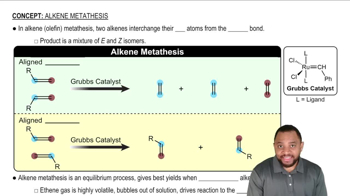
Alkene Metathesis Concept 1

Stereochemistry

Stereochemistry refers to the study of the spatial arrangement of atoms in molecules and how this affects their chemical behavior. In reactions involving alkenes, stereochemistry can lead to different isomers, such as cis and trans forms. However, in certain reactions, especially those involving terminal alkenes, the formation of a single product may render stereochemical details unnecessary.
Recommended video:
1:38
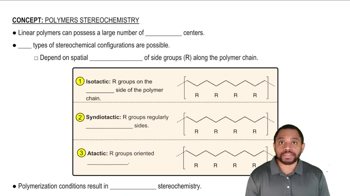
Polymer Stereochemistry Concept 1

Reaction Mechanism

A reaction mechanism outlines the step-by-step process by which reactants transform into products. Understanding the mechanism helps predict the products formed and their stereochemical outcomes. In the case of terminal alkenes, specific mechanisms may lead to a predominant product, making it unnecessary to specify stereochemistry if only one stereoisomer is formed.
Recommended video:
Guided course
02:16
Heck Reaction Mechanism