Ch.6 - Alkyl Halides; Nucleophilic Substitution
Wade - Organic Chemistry 9th Edition
Wade9th EditionOrganic ChemistryISBN: 9780135213728Not the one you use?Change textbook
Chapter 6, Problem 6c

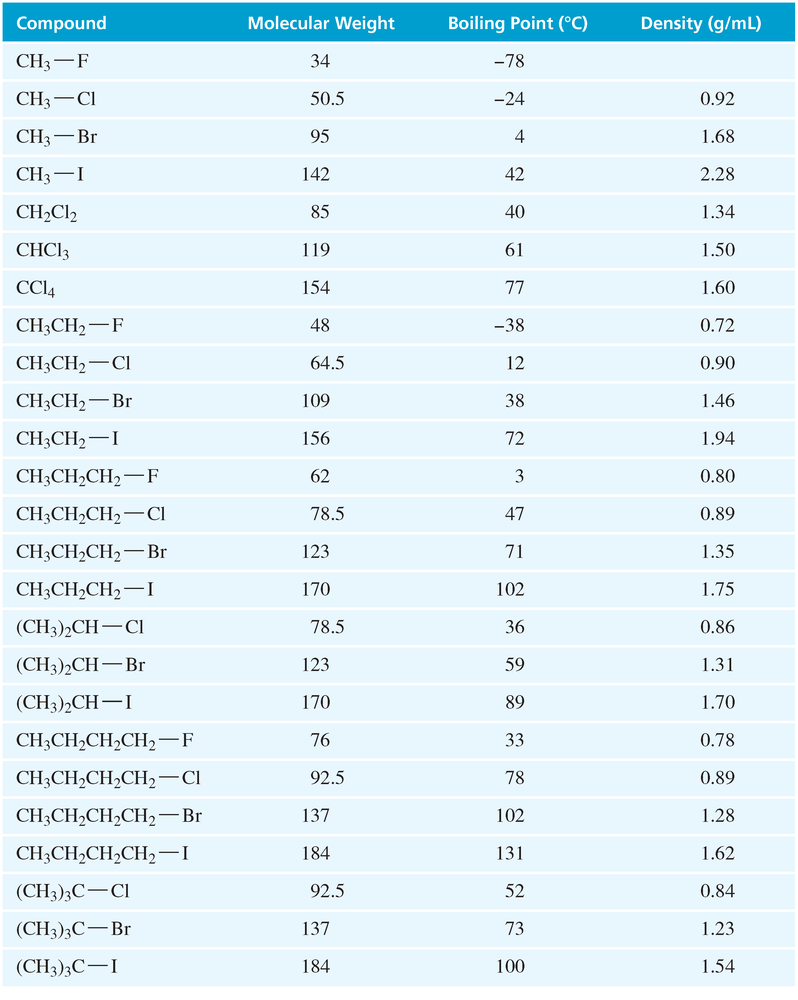
For each pair of compounds, predict which compound has the higher boiling point. Check [TABLE 6-2] to see if your prediction was right; then explain why that compound has the higher boiling point.
c. 1-bromobutane and 1-chlorobutane

Verified step by step guidance
1
Identify the two compounds in question: 1-bromobutane and 1-chlorobutane. These are alkyl halides where bromine and chlorine are attached to a butane chain.
Consider the molecular weight of each compound. 1-bromobutane has a higher molecular weight than 1-chlorobutane because bromine is heavier than chlorine.
Analyze the intermolecular forces present. Both compounds exhibit van der Waals forces, but 1-bromobutane will have stronger dispersion forces due to its larger electron cloud compared to 1-chlorobutane.
Check the boiling points in the provided table. 1-bromobutane has a boiling point of 102°C, while 1-chlorobutane has a boiling point of 78°C.
Explain the difference in boiling points: The higher boiling point of 1-bromobutane is due to its greater molecular weight and stronger dispersion forces, which require more energy to overcome during the phase transition from liquid to gas.

Verified video answer for a similar problem:

This video solution was recommended by our tutors as helpful for the problem above.
Video duration:
2m
Was this helpful?

Key Concepts

Here are the essential concepts you must grasp in order to answer the question correctly.

Boiling Point

The boiling point of a compound is the temperature at which its vapor pressure equals the external pressure, causing it to change from liquid to gas. It is influenced by intermolecular forces, molecular weight, and structural characteristics. Generally, compounds with stronger intermolecular forces, such as hydrogen bonding or dipole-dipole interactions, exhibit higher boiling points.
Recommended video:
Guided course
03:08
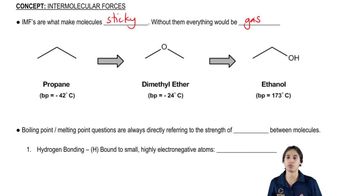
How IMFs are related to melting and boiling points.

Intermolecular Forces

Intermolecular forces are the forces of attraction or repulsion between molecules. The main types include London dispersion forces, dipole-dipole interactions, and hydrogen bonding. In the case of halogenated compounds like 1-bromobutane and 1-chlorobutane, the strength of these forces significantly affects their boiling points, with stronger dipole-dipole interactions leading to higher boiling points.
Recommended video:
Guided course
03:01
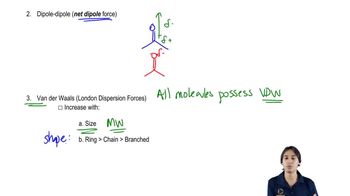
How Van der Waals forces work.

Molecular Weight

Molecular weight, or molar mass, is the mass of a molecule calculated as the sum of the atomic weights of its constituent atoms. Generally, as molecular weight increases, the boiling point tends to increase due to the greater surface area and stronger London dispersion forces. In comparing 1-bromobutane and 1-chlorobutane, the difference in molecular weights contributes to their boiling point differences.
Recommended video:
Guided course
08:41
Review of Molecular Orbitals