
Ch. 16 - Aromatic Compounds
Wade - Organic Chemistry 9th Edition
Wade9th EditionOrganic ChemistryISBN: 9780135213728Not the one you use?Change textbook
Chapter 16, Problem 47

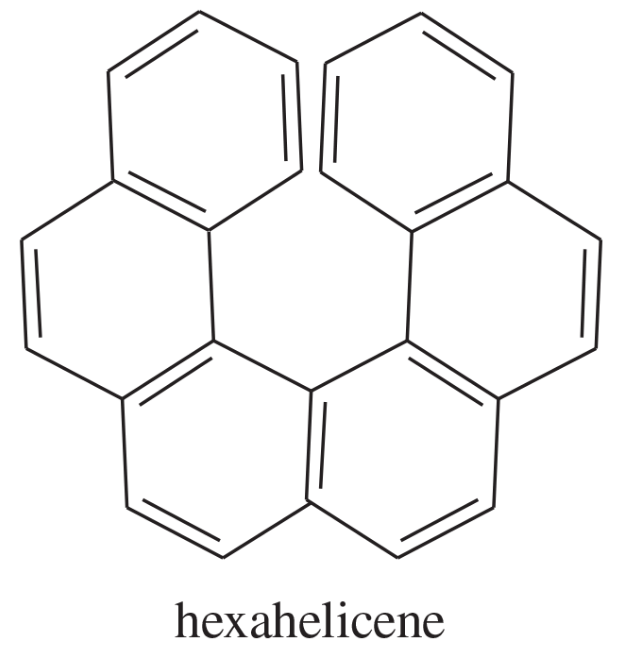
Hexahelicene seems a poor candidate for optical activity because all its carbon atoms are sp2 hybrids and presumably flat. Nevertheless, hexahelicene has been synthesized and separated into enantiomers. Its optical rotation is enormous: [α]D = 3700°. Explain why hexahelicene is optically active, and speculate as to why the rotation is so large.

Verified step by step guidance
1
Hexahelicene is composed of six benzene rings fused together in a helical arrangement. Although all carbon atoms are sp2 hybridized, the molecule adopts a non-planar, helical structure due to steric hindrance between the rings.
The helical structure introduces chirality into the molecule because it cannot be superimposed on its mirror image. This makes hexahelicene optically active, allowing it to exist as enantiomers.
The large optical rotation ([α]D = 3700°) is attributed to the extended conjugation of the π-electrons across the aromatic rings, which enhances the interaction of the molecule with polarized light.
The helical twist in the molecule creates a strong asymmetry, amplifying the optical rotation. This asymmetry is a result of the steric strain and the spatial arrangement of the rings, which prevents the molecule from adopting a flat conformation.
In summary, hexahelicene's optical activity arises from its chiral, helical structure, and the large optical rotation is due to the combination of extended conjugation and pronounced asymmetry in the molecule.

Verified video answer for a similar problem:

This video solution was recommended by our tutors as helpful for the problem above.
Video duration:
3m
Was this helpful?

Key Concepts

Here are the essential concepts you must grasp in order to answer the question correctly.

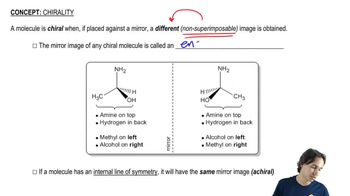
Chirality

Chirality refers to the geometric property of a molecule that makes it non-superimposable on its mirror image, much like left and right hands. For a molecule to be chiral, it typically must have at least one chiral center, often a carbon atom bonded to four different substituents. In the case of hexahelicene, despite all carbon atoms being sp2 hybridized, the unique helical structure introduces a form of chirality that allows for the existence of enantiomers.
Recommended video:
Guided course
05:10
What is chirality?

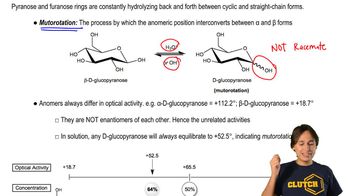
Optical Activity

Optical activity is the ability of a chiral substance to rotate the plane of polarized light. This phenomenon occurs because chiral molecules interact differently with the two enantiomers of polarized light. The degree of rotation is quantified as specific rotation, and in hexahelicene's case, the large value of [α]D = 3700° indicates a strong interaction with polarized light, likely due to its unique helical structure and the arrangement of its substituents.
Recommended video:
Guided course
08:17
Mutorotation and Optical Activity

Helical Structure

The helical structure of hexahelicene contributes significantly to its optical activity. This three-dimensional arrangement creates a unique spatial orientation that enhances the molecule's chirality. The twisting of the carbon framework leads to a significant difference in how the two enantiomers interact with polarized light, resulting in the observed large optical rotation. The rigidity and planarity of the helical structure also prevent rapid interconversion between enantiomers, stabilizing their optical activity.
Recommended video:
2:07
Tertiary Protein Structure Concept 1
Related Practice
Textbook Question

The ribonucleosides that make up ribonucleic acid (RNA) are composed of D-ribose (a sugar) and four heterocyclic “bases.” The general structure of a ribonucleoside is shown here.

The four heterocyclic bases are cytosine, uracil, guanine, and adenine. Cytosine and uracil are called pyrimidine bases because their structures resemble pyrimidine. Guanine and adenine are called purine bases because their structures resemble purine.

c. Do any of these bases have easily formed tautomers that are aromatic? (Consider moving a proton from nitrogen to a carbonyl group to form a phenolic derivative.)

697
views
Textbook Question

An unknown compound gives the following mass, IR, and NMR spectra. Propose a structure, and show how it is consistent with the spectra. Show the fragmentations that give the prominent peaks at m/z 127 and 155 in the mass spectrum.

<IMAGES>

3377
views
Textbook Question

Chlorophyll is the general name for a family of compounds present in algae and green plants. These molecules use the energy in sunlight to convert carbon dioxide and water into carbohydrates and other energy sources. At the heart of chlorophyll (shown below) is a large-ring magnesium complex called a chlorin. Circle each double bond in the large cyclic conjugated pi system that makes it aromatic. How many pi electrons are in this aromatic system?

996
views
Textbook Question

Consider the following compound, which has been synthesized and characterized:

a. Assuming this molecule is entirely conjugated, do you expect it to be aromatic, antiaromatic, or nonaromatic?

b. Why was this molecule synthesized with three tert-butyl substituents? Why not make the unsubstituted compound and study it instead?

818
views