Write the initiation, propagation, and termination steps for the monochlorination of cyclohexane.
Verified step by step guidance
1
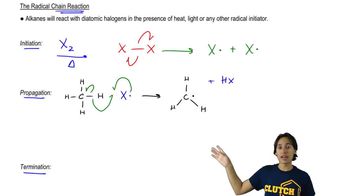
Write the initiation step: In this step, the chlorine molecule (Cl₂) undergoes homolytic cleavage under the influence of UV light or heat to form two chlorine radicals. Represent this as: Cl₂ → 2Cl•.
Write the first propagation step: A chlorine radical (Cl•) reacts with cyclohexane (C₆H₁₂), abstracting a hydrogen atom to form hydrogen chloride (HCl) and a cyclohexyl radical (C₆H₁₁•). Represent this as: Cl• + C₆H₁₂ → HCl + C₆H₁₁•.
Write the second propagation step: The cyclohexyl radical (C₆H₁₁•) reacts with another chlorine molecule (Cl₂), forming chlorocyclohexane (C₆H₁₁Cl) and regenerating a chlorine radical (Cl•). Represent this as: C₆H₁₁• + Cl₂ → C₆H₁₁Cl + Cl•.
Write the termination steps: Termination occurs when two radicals combine to form a stable molecule. Examples include: (1) Cl• + Cl• → Cl₂, (2) C₆H₁₁• + Cl• → C₆H₁₁Cl, and (3) C₆H₁₁• + C₆H₁₁• → C₆H₁₁-C₆H₁₁.
Ensure the overall reaction is balanced: Combine the initiation, propagation, and termination steps to confirm that the overall reaction is the substitution of one hydrogen atom in cyclohexane with a chlorine atom, forming chlorocyclohexane and HCl.
Verified video answer for a similar problem:
This video solution was recommended by our tutors as helpful for the problem above
Video duration:
3m
Play a video:
0 Comments
Key Concepts
Here are the essential concepts you must grasp in order to answer the question correctly.
Free Radical Halogenation
Free radical halogenation is a reaction mechanism where alkanes react with halogens to form alkyl halides. This process involves the generation of free radicals, which are highly reactive species with unpaired electrons. The reaction typically occurs in three stages: initiation, propagation, and termination, each playing a crucial role in the overall mechanism.
The initiation step involves the formation of free radicals from halogen molecules, usually through the application of heat or light. For monochlorination of cyclohexane, chlorine molecules (Cl2) dissociate into two chlorine radicals (Cl•), which are essential for starting the reaction. This step is critical as it sets the stage for the subsequent propagation steps.
Propagation steps involve the reaction of the generated radicals with cyclohexane, leading to the formation of new radicals and the desired product, chlorocyclohexane. This cycle continues until the radicals are consumed. The termination step occurs when two radicals combine to form a stable molecule, effectively stopping the reaction. Understanding these steps is vital for predicting the products and yields of the reaction.