Convert the following condensed structures into skeletal structures: c.
Verified step by step guidance
1
Step 1: Identify the main chain in the condensed structure. The main chain is the longest continuous chain of carbon atoms. In this case, the main chain consists of 8 carbon atoms.
Step 2: Locate and identify the substituents attached to the main chain. The condensed structure shows two methyl groups (CH₃) attached to the main chain at specific positions.
Step 3: Determine the positions of the substituents on the main chain. The first methyl group is attached to the third carbon atom, and the second methyl group is attached to the sixth carbon atom of the main chain.
Step 4: Draw the skeletal structure by representing the main chain as a zigzag line (each vertex represents a carbon atom) and adding branches for the substituents at the appropriate positions. Use lines to represent bonds and omit hydrogen atoms for simplicity.
Step 5: Verify the skeletal structure by counting the total number of carbon atoms and ensuring that the substituents are correctly placed according to the condensed structure.
Verified video answer for a similar problem:
This video solution was recommended by our tutors as helpful for the problem above
Video duration:
4m
Play a video:
0 Comments
Key Concepts
Here are the essential concepts you must grasp in order to answer the question correctly.
Condensed Structures
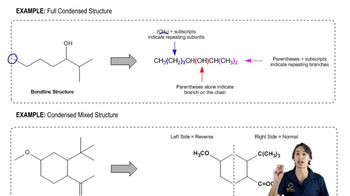
Condensed structures are a way of representing organic molecules that show the connectivity of atoms without depicting all the bonds explicitly. In these structures, atoms are often grouped together to indicate how they are connected, and hydrogen atoms attached to carbons are usually omitted for simplicity. Understanding condensed structures is essential for converting them into skeletal structures, as it requires recognizing the functional groups and overall molecular framework.
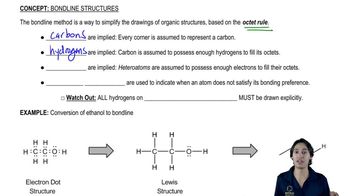
Skeletal structures, also known as line-angle formulas, are a simplified representation of organic molecules where carbon atoms are represented by vertices or ends of lines, and hydrogen atoms are implied. This format emphasizes the connectivity and geometry of the molecule while omitting explicit hydrogen atoms. Familiarity with skeletal structures is crucial for visualizing molecular shapes and understanding reactivity in organic chemistry.
Functional groups are specific groups of atoms within molecules that are responsible for the characteristic chemical reactions of those molecules. They dictate the properties and reactivity of organic compounds, making them essential for understanding how to convert condensed structures into skeletal forms. Recognizing functional groups helps in identifying the key features of a molecule that influence its behavior in chemical reactions.