
Ch. 16 - Aromatic Compounds
Wade - Organic Chemistry 9th Edition
Wade9th EditionOrganic ChemistryISBN: 9780135213728Not the one you use?Change textbook
Chapter 16, Problem 12d,e,f

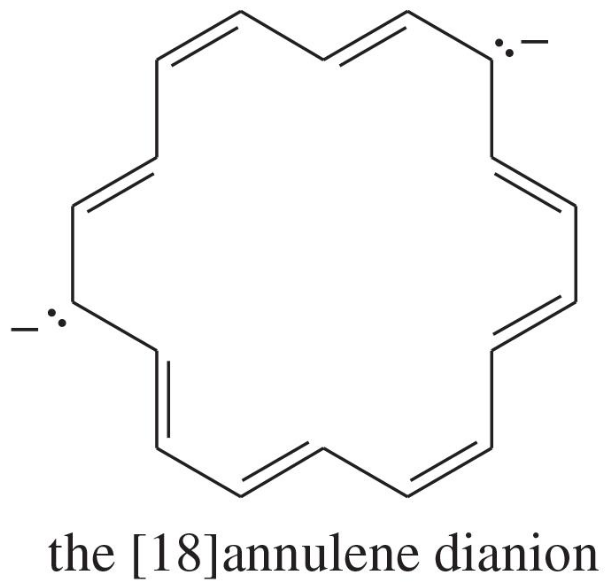
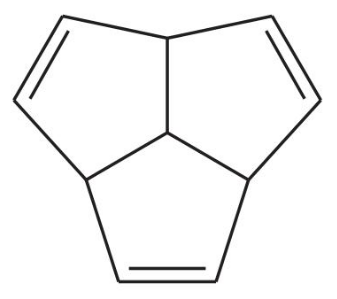
Explain why each compound or ion should be aromatic, antiaromatic, or nonaromatic.
(d)
(e)
(f) the [20]annulene dication

Verified step by step guidance
1
Step 1: Recall the criteria for aromaticity. A compound is aromatic if it satisfies the following conditions: (a) It is cyclic, (b) It is planar, (c) It has a conjugated π-electron system, and (d) It follows Hückel's rule, which states that the molecule must have (4n + 2) π-electrons, where n is an integer.
Step 2: Analyze compound (i). This structure is cyclic and conjugated, with alternating double bonds. It has 10 π-electrons (counting the electrons from the double bonds and lone pairs). Applying Hückel's rule, 10 π-electrons fit the formula (4n + 2) with n = 2, making it aromatic. Additionally, the molecule appears planar, which supports aromaticity.
Step 3: Analyze compound (ii). This structure is cyclic and conjugated, but it has 4 π-electrons (from the two double bonds). Applying Hückel's rule, 4 π-electrons do not fit the formula (4n + 2). Instead, it fits the formula 4n, which makes it antiaromatic. Furthermore, the molecule is planar, which supports antiaromaticity.
Step 4: Analyze compound (iii), the [20]annulene dication. This structure is cyclic and conjugated, with alternating double bonds. The dication removes two electrons from the π-system, leaving 18 π-electrons. Applying Hückel's rule, 18 π-electrons fit the formula (4n + 2) with n = 4, making it aromatic. The molecule is also planar, which supports aromaticity.
Step 5: Summarize the findings. Compound (i) is aromatic due to its cyclic, planar structure and 10 π-electrons satisfying Hückel's rule. Compound (ii) is antiaromatic due to its cyclic, planar structure and 4 π-electrons fitting the 4n formula. Compound (iii), the [20]annulene dication, is aromatic due to its cyclic, planar structure and 18 π-electrons satisfying Hückel's rule.

Verified video answer for a similar problem:

This video solution was recommended by our tutors as helpful for the problem above.
Video duration:
12m
Was this helpful?

Key Concepts

Here are the essential concepts you must grasp in order to answer the question correctly.

Aromaticity

Aromaticity refers to the property of cyclic compounds that exhibit enhanced stability due to delocalized π electrons. For a compound to be aromatic, it must be cyclic, planar, and follow Hückel's rule, which states that it should have 4n + 2 π electrons, where n is a non-negative integer. This delocalization allows for resonance, contributing to the compound's stability and unique chemical properties.

Antiaromaticity

Antiaromaticity is the opposite of aromaticity and describes cyclic compounds that are destabilized by the presence of π electrons. A compound is considered antiaromatic if it is cyclic, planar, and contains 4n π electrons, leading to increased electron-electron repulsion and instability. This instability often results in a higher reactivity compared to nonaromatic compounds.

Nonaromaticity

Nonaromatic compounds do not meet the criteria for either aromaticity or antiaromaticity. These compounds can be acyclic, non-planar, or lack the required number of π electrons. As a result, they do not exhibit the special stability associated with aromatic compounds nor the instability of antiaromatic compounds, leading to typical reactivity patterns found in aliphatic compounds.
Related Practice
Textbook Question

When 3-chlorocyclopropene is treated with AgBF4, AgCl precipitates. The organic product can be obtained as a crystalline material, soluble in polar solvents such as nitromethane but insoluble in hexane. When the crystalline material is dissolved in nitromethane containing KCl, the original 3-chlorocyclopropene is regenerated. Determine the structure of the crystalline material, and write equations for its formation and its reaction with chloride ion.

927
views
Textbook Question

The following hydrocarbon has an unusually large dipole moment. Explain how a large dipole moment might arise.

852
views
Textbook Question

(a) Draw the molecular orbitals for the cyclopropenyl case.

(Because there are three p orbitals, there must be three MOs: one all-bonding MO and one degenerate pair of MOs.)

(b) Draw an energy diagram for the cyclopropenyl MOs. (The polygon rule is helpful.) Label each MO as bonding, nonbonding, or antibonding, and add the nonbonding line. Notice that it goes through the approximate average of the MOs.

(c) Add electrons to your energy diagram to show the configuration of the cyclopropenyl cation and the cyclopropenyl anion. Which is aromatic and which is antiaromatic?

1324
views
Textbook Question

The polarization of a carbonyl group can be represented by a pair of resonance structures:

Cyclopropenone and cycloheptatrienone are more stable than anticipated. Cyclopentadienone, however, is relatively unstable and rapidly undergoes a Diels–Alder dimerization. Explain.

1130
views
Textbook Question

Repeat Problem 16-10 for the cyclopentadienyl ions. Draw one all-bonding MO, then a pair of degenerate MOs, and then a final pair of degenerate MOs. Draw the energy diagram, fill in the electrons, and confirm the electronic configurations of the cyclopentadienyl cation and anion.

879
views
Textbook Question

Explain why each compound or ion should be aromatic, antiaromatic, or nonaromatic.

(a)

(b)

(c)

1352
views