Ch.1 - Structure and Bonding
Wade - Organic Chemistry 9th Edition
Wade9th EditionOrganic ChemistryISBN: 9780135213728Not the one you use?Change textbook
Chapter 1, Problem 12c,d

Give Lewis structures corresponding to the following line–angle structures. Give the molecular formula for each structure.
(c)
(d)

Verified step by step guidance
1
Step 1: Identify the line-angle structure for compound (c). The structure is a five-membered ring with two double bonds and a nitrogen atom with a hydrogen attached. This is pyrrole.
Step 2: Draw the Lewis structure for pyrrole. Start by drawing a five-membered ring. Add two double bonds between the carbon atoms. Place a nitrogen atom in the ring with a single bond to a hydrogen atom.
Step 3: Ensure that each carbon atom has four bonds. The carbons involved in double bonds will have one additional single bond to another carbon or hydrogen atom.
Step 4: For compound (d), identify the line-angle structure. It is a five-membered ring with an alcohol group (OH) attached to one of the carbon atoms. This is cyclopentanol.
Step 5: Draw the Lewis structure for cyclopentanol. Start with a five-membered ring. Attach an OH group to one of the carbon atoms. Ensure each carbon has four bonds, adding hydrogen atoms where necessary.

Verified video answer for a similar problem:

This video solution was recommended by our tutors as helpful for the problem above.
Video duration:
7m
Was this helpful?

Key Concepts

Here are the essential concepts you must grasp in order to answer the question correctly.

Lewis Structures

Lewis structures are diagrams that represent the bonding between atoms in a molecule and the lone pairs of electrons that may exist. They use dots to represent valence electrons and lines to represent bonds between atoms. Understanding how to draw Lewis structures is essential for visualizing molecular geometry and predicting reactivity.
Recommended video:
Guided course
04:12
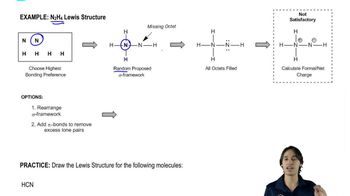
Drawing the Lewis Structure for N2H4.

Line-Angle Structures

Line-angle structures, also known as skeletal structures, are a simplified way of drawing organic molecules where lines represent bonds between carbon atoms, and vertices represent carbon atoms. Hydrogen atoms attached to carbons are usually omitted for simplicity. This representation helps in quickly visualizing the structure and connectivity of organic compounds.
Recommended video:
Guided course
02:46
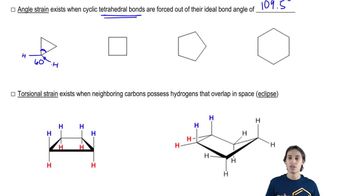
What is angle strain?

Molecular Formula

A molecular formula indicates the number and type of atoms present in a molecule, represented by chemical symbols and subscripts. It provides essential information about the composition of the compound but does not convey structural information. Understanding how to derive the molecular formula from a given structure is crucial for identifying the compound and predicting its properties.
Recommended video:
Guided course
02:17
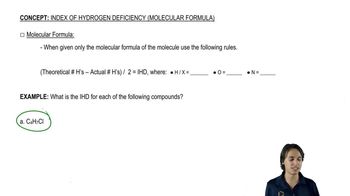
How to use IHD with molecular formula.