Ch.3 - Structure and Stereochemistry of Alkanes
Wade - Organic Chemistry 9th Edition
Wade9th EditionOrganic ChemistryISBN: 9780135213728Not the one you use?Change textbook
Chapter 3, Problem 3a

Write structures for the following compounds.
a. 3-ethyl-4-methylhexane
b. 3-ethyl-5-isobutyl-3-methylnonane
c. 4-tert-butyl-2-methylheptane
d. 5-isopropyl-3,3,4-trimethyloctane

Verified step by step guidance
1
Step 1: Understand the IUPAC naming conventions. The name of an organic compound provides information about the number of carbon atoms in the longest chain (the parent chain), the presence and position of substituents, and the type of bonds between carbon atoms.
Step 2: For compound a, 3-ethyl-4-methylhexane, identify the parent chain. 'Hexane' indicates a six-carbon chain. Number the chain from the end nearest a substituent to give the lowest numbers to the substituents. Place an ethyl group at the 3rd carbon and a methyl group at the 4th carbon.
Step 3: For compound b, 3-ethyl-5-isobutyl-3-methylnonane, identify the parent chain. 'Nonane' indicates a nine-carbon chain. Number the chain to give the lowest numbers to the substituents. Place an ethyl group at the 3rd carbon, an isobutyl group at the 5th carbon, and a methyl group at the 3rd carbon.
Step 4: For compound c, 4-tert-butyl-2-methylheptane, identify the parent chain. 'Heptane' indicates a seven-carbon chain. Number the chain to give the lowest numbers to the substituents. Place a tert-butyl group at the 4th carbon and a methyl group at the 2nd carbon.
Step 5: For compound d, 5-isopropyl-3,3,4-trimethyloctane, identify the parent chain. 'Octane' indicates an eight-carbon chain. Number the chain to give the lowest numbers to the substituents. Place an isopropyl group at the 5th carbon and three methyl groups at the 3rd and 4th carbons.

Verified video answer for a similar problem:

This video solution was recommended by our tutors as helpful for the problem above.
Video duration:
9m
Was this helpful?

Key Concepts

Here are the essential concepts you must grasp in order to answer the question correctly.

IUPAC Nomenclature

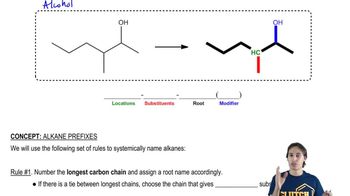
IUPAC nomenclature is a systematic method of naming organic chemical compounds as recommended by the International Union of Pure and Applied Chemistry. It involves identifying the longest carbon chain, numbering the chain to give substituents the lowest possible numbers, and naming substituents as prefixes. Understanding this system is crucial for correctly interpreting and drawing the structures of organic compounds.
Recommended video:
Guided course
03:43
The different parts of an IUPAC name

Alkyl Groups

Alkyl groups are side chains or substituents derived from alkanes by removing a hydrogen atom. Common alkyl groups include methyl, ethyl, isopropyl, and tert-butyl. Recognizing these groups and their structures is essential for constructing the correct molecular structure of a compound based on its name.
Recommended video:
Guided course
03:19
Sodium Alkynide Alkylation

Structural Isomers

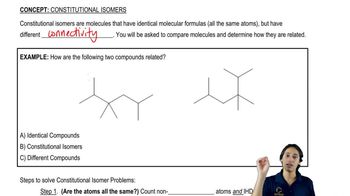
Structural isomers are compounds with the same molecular formula but different structural arrangements of atoms. In organic chemistry, understanding how to arrange atoms to form different isomers is key to drawing accurate structures. This concept helps in visualizing how substituents can be positioned differently on the carbon skeleton.
Recommended video:
Guided course
01:10
What is a constitutional isomer?