Ch. 21 - Conjugated Systems I: Stability and Addition Reactions
Mullins - Organic Chemistry: A Learner Centered Approach 1st Edition
Mullins1st EditionOrganic Chemistry: A Learner Centered ApproachISBN: 9780137566471Not the one you use?Change textbook
Chapter 20, Problem 2c

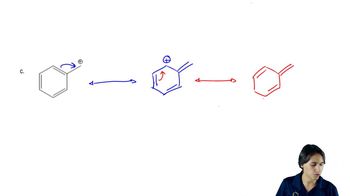
Draw all possible resonance structures for the reactive intermediates shown.
(c) Chemical structure diagram showing a benzene ring with a reactive intermediate and arrows indicating resonance structures.

Verified step by step guidance
1
Identify the reactive intermediate shown in the image. The structure contains a benzene ring and a benzylic radical (a single unpaired electron) at the benzylic position. This radical is highly stabilized by resonance with the aromatic ring.
Begin by drawing the first resonance structure. Move one of the π-electrons from the benzene ring to form a double bond between the benzylic carbon and the adjacent carbon in the ring. The unpaired electron will now be located on the carbon in the ring where the π-electrons were removed.
Draw the second resonance structure. Move the π-electrons from the next double bond in the benzene ring to form a new double bond adjacent to the benzylic carbon. The unpaired electron will shift to the next carbon in the ring.
Continue the process to draw the third resonance structure. Move the π-electrons from the next double bond in the benzene ring to form a new double bond adjacent to the benzylic carbon. The unpaired electron will now be located on the final carbon in the ring.
Verify all resonance structures. Ensure that the aromaticity of the benzene ring is preserved and that the unpaired electron is delocalized across the ring, stabilizing the benzylic radical through resonance.

Verified video answer for a similar problem:

This video solution was recommended by our tutors as helpful for the problem above.
Was this helpful?

Key Concepts

Here are the essential concepts you must grasp in order to answer the question correctly.

Resonance Structures

Resonance structures are different Lewis structures for the same molecule that depict the same arrangement of atoms but differ in the distribution of electrons. These structures help illustrate the delocalization of electrons within a molecule, which can stabilize reactive intermediates. Understanding resonance is crucial for predicting the reactivity and stability of organic compounds.
Recommended video:
Guided course
03:04
Drawing Resonance Structures

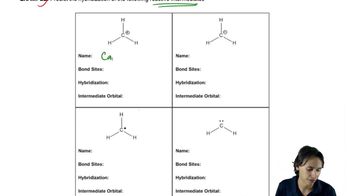
Reactive Intermediates

Reactive intermediates are transient species that form during the course of a chemical reaction and are typically unstable. Common types include carbocations, carbanions, and free radicals. Analyzing these intermediates is essential for understanding reaction mechanisms and predicting the outcome of organic reactions.
Recommended video:
Guided course
02:47
Introduction to the reactive intermediates.

Electron Delocalization

Electron delocalization refers to the distribution of electrons across multiple atoms in a molecule, rather than being localized between two atoms. This phenomenon is a key feature of resonance and contributes to the stability of reactive intermediates. Recognizing how electrons can be shared among different atoms is vital for drawing accurate resonance structures.
Recommended video:
Guided course
03:54
The 18 and 16 Electron Rule