Ch. 2 - General Chemistry Translated: Finding the Electrons
Mullins - Organic Chemistry: A Learner Centered Approach 1st Edition
Mullins1st EditionOrganic Chemistry: A Learner Centered ApproachISBN: 9780137566471Not the one you use?Change textbook
Chapter 1, Problem 61a

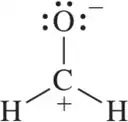
By moving an electron pair, draw a better Lewis structure that minimizes formal charges.
(a) Lewis structure showing a carbon atom bonded to two hydrogen atoms and an oxygen atom with formal charges indicated.

Verified step by step guidance
1
Identify the formal charges on each atom in the given Lewis structure. The oxygen atom has a negative formal charge (-1), and the central carbon atom bonded to oxygen has a positive formal charge (+1).
Recall that a better Lewis structure minimizes formal charges by redistributing electron pairs. In this case, moving an electron pair from the oxygen atom to form a double bond with the positively charged carbon can help neutralize the charges.
Draw a new Lewis structure where the oxygen atom forms a double bond with the central carbon atom. This involves moving one lone pair from oxygen to create a π bond with carbon.
Recalculate the formal charges in the new structure. The oxygen atom should now have a formal charge of 0, and the central carbon atom should also have a formal charge of 0, resulting in a more stable structure.
Verify that the octet rule is satisfied for all atoms in the new structure. Ensure that oxygen has 8 electrons in its valence shell and that the central carbon atom also has 8 electrons.

Verified video answer for a similar problem:

This video solution was recommended by our tutors as helpful for the problem above.
Video duration:
2m
Was this helpful?

Key Concepts

Here are the essential concepts you must grasp in order to answer the question correctly.

Lewis Structures

Lewis structures are diagrams that represent the bonding between atoms in a molecule and the lone pairs of electrons that may exist. They help visualize the arrangement of electrons and the connectivity of atoms, which is crucial for understanding molecular geometry and reactivity. In organic chemistry, drawing accurate Lewis structures is essential for predicting the behavior of molecules in chemical reactions.
Recommended video:
Guided course
04:12
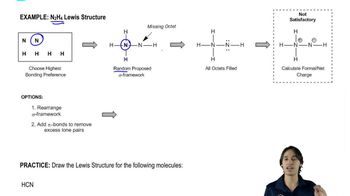
Drawing the Lewis Structure for N2H4.

Formal Charge

Formal charge is a concept used to determine the charge of an atom in a molecule based on its valence electrons and the electrons it shares in bonds. It is calculated using the formula: Formal Charge = Valence Electrons - (Non-bonding Electrons + 1/2 Bonding Electrons). Minimizing formal charges in a Lewis structure leads to a more stable and favorable molecular configuration, as it reflects a more accurate representation of electron distribution.
Recommended video:
Guided course
01:34
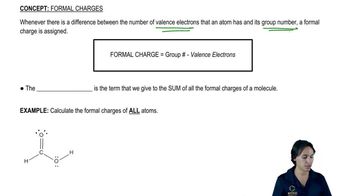
Calculating formal and net charge.

Electron Pair Movement

Electron pair movement refers to the process of shifting electron pairs in a Lewis structure to achieve a more stable arrangement of atoms and minimize formal charges. This can involve forming new bonds or breaking existing ones, which alters the connectivity of the molecule. Understanding how to effectively move electron pairs is crucial for optimizing Lewis structures and predicting the reactivity of organic compounds.
Recommended video:
2:56
Base Pairing Concept 1