Ch. 22 - Condensations and Alpha Substitutions of Carbonyl Compounds
Wade - Organic Chemistry 9th Edition
Wade9th EditionOrganic ChemistryISBN: 9780135213728Not the one you use?Change textbook
Chapter 22, Problem 9a,b

Show how you would accomplish each conversion using an enamine synthesis with pyrrolidine as the secondary amine.
(a) cyclopentanone → 2-allylcyclopentanone
(b) pentan-3-one → 2-methyl-1-phenylpentan-3-one

Verified step by step guidance
1
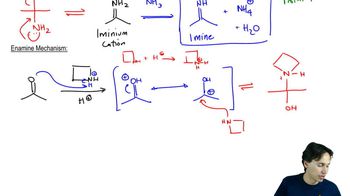
Step 1: Understand the enamine synthesis mechanism. Enamines are formed by the reaction of a secondary amine (like pyrrolidine) with a ketone. The enamine acts as a nucleophile in subsequent reactions, allowing for alkylation or acylation at the alpha-carbon of the ketone.
Step 2: For part (a), cyclopentanone → 2-allylcyclopentanone: React cyclopentanone with pyrrolidine to form the enamine intermediate. This involves the condensation of the ketone with pyrrolidine, removing water to form the enamine.
Step 3: Perform an alkylation reaction. Treat the enamine intermediate with allyl bromide (CH₂=CH-CH₂Br). The enamine's nucleophilic alpha-carbon will attack the electrophilic carbon in allyl bromide, forming a new C-C bond and introducing the allyl group.
Step 4: Hydrolyze the iminium ion formed after alkylation. Add water under acidic conditions to regenerate the ketone, yielding 2-allylcyclopentanone.
Step 5: For part (b), pentan-3-one → 2-methyl-1-phenylpentan-3-one: Follow a similar process. First, react pentan-3-one with pyrrolidine to form the enamine. Then, perform an alkylation using benzyl chloride (C₆H₅CH₂Cl) to introduce the phenyl group. Finally, hydrolyze the iminium ion to regenerate the ketone, yielding the desired product.

Verified video answer for a similar problem:

This video solution was recommended by our tutors as helpful for the problem above.
Video duration:
10m
Was this helpful?

Key Concepts

Here are the essential concepts you must grasp in order to answer the question correctly.

Enamine Synthesis

Enamine synthesis involves the formation of enamines from carbonyl compounds and secondary amines. In this process, a carbonyl compound, such as a ketone or aldehyde, reacts with a secondary amine (like pyrrolidine) to form an enamine, which can then undergo further reactions, such as alkylation, to create more complex molecules.
Recommended video:
Guided course
06:25
Enamine Mechanism

Alkylation of Enamines

Alkylation of enamines is a key step in organic synthesis where the enamine acts as a nucleophile, attacking an electrophile to form a new carbon-carbon bond. This reaction allows for the introduction of various alkyl groups, enabling the transformation of simple carbonyl compounds into more complex structures, such as the desired products in the given conversions.
Recommended video:
Guided course
06:25
Enamine Mechanism

Reactivity of Carbonyl Compounds

Carbonyl compounds, including ketones and aldehydes, are highly reactive due to the polarized carbon-oxygen double bond. This reactivity allows them to participate in various nucleophilic addition reactions, including the formation of enamines. Understanding the reactivity of these compounds is crucial for predicting the outcomes of synthetic transformations in organic chemistry.
Recommended video:
Guided course
01:40
Defining meso compounds.