The C―H σ bond length in ethane is 1.09 Å. The C―H σ bond in ethene is 1.07 Å. Explain.
Ch. 2 - General Chemistry Translated: Finding the Electrons

Mullins1st EditionOrganic Chemistry: A Learner Centered ApproachISBN: 9780137566471Not the one you use?Change textbook
All textbooks
Mullins 1st Edition
Ch. 2 - General Chemistry Translated: Finding the Electrons
Problem 82
Mullins 1st Edition
Ch. 2 - General Chemistry Translated: Finding the Electrons
Problem 82Chapter 1, Problem 82
Looking ahead in Chapter 4, we explain that molecules like CH3+ are Lewis acids or electron pair acceptors. Into which orbital would the new electron pair go?
Verified step by step guidance1
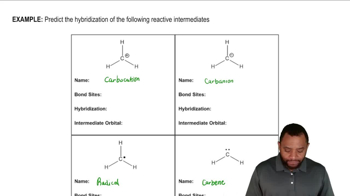
Understand the context: CH₃⁺ is a carbocation, which means it has a positively charged carbon atom. This positive charge arises because the carbon atom has only six electrons in its valence shell, making it electron-deficient and a Lewis acid (electron pair acceptor).
Recall the electronic configuration of carbon: Carbon has an atomic number of 6, so its ground-state electronic configuration is 1s² 2s² 2p². In CH₃⁺, the carbon atom is sp² hybridized, leaving one unhybridized p orbital.
Visualize the molecular geometry: CH₃⁺ has a trigonal planar geometry due to sp² hybridization. The three sp² orbitals form sigma bonds with the three hydrogen atoms, while the unhybridized p orbital remains empty and perpendicular to the plane of the molecule.
Determine the orbital that can accept the electron pair: The empty unhybridized p orbital on the carbon atom is the orbital that can accept the incoming electron pair. This is because it is the only orbital available and not involved in bonding.
Conclude: The new electron pair would go into the empty p orbital of the carbon atom in CH₃⁺, which is aligned perpendicular to the plane of the molecule.

Verified video answer for a similar problem:
This video solution was recommended by our tutors as helpful for the problem above.
Video duration:
2mWas this helpful?
Key Concepts
Here are the essential concepts you must grasp in order to answer the question correctly.
Lewis Acids and Bases
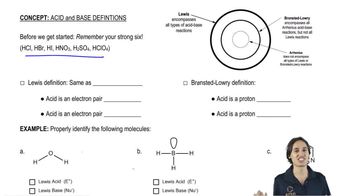
Lewis acids are defined as substances that can accept an electron pair, while Lewis bases donate an electron pair. This concept is crucial for understanding how certain molecules, like CH₃⁺, interact with other species in chemical reactions. The ability of a Lewis acid to accept electrons is fundamental in predicting the outcome of reactions involving these species.
Recommended video:
Guided course
The Lewis definition of acids and bases.
Molecular Orbitals
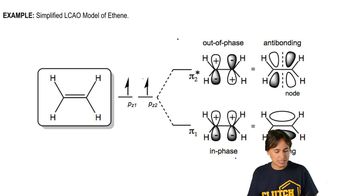
Molecular orbitals are formed by the combination of atomic orbitals when atoms bond together. In the case of CH₃⁺, the molecular orbitals determine where the new electron pair will reside after it is accepted by the Lewis acid. Understanding the arrangement and energy levels of these orbitals is essential for predicting the behavior of the molecule in chemical reactions.
Recommended video:
Guided course
Review of Molecular Orbitals
Orbital Hybridization
Orbital hybridization is the process by which atomic orbitals mix to form new hybrid orbitals that can accommodate bonding. In CH₃⁺, the carbon atom undergoes sp³ hybridization, resulting in four equivalent orbitals that can form bonds. Recognizing the type of hybridization helps in determining the geometry of the molecule and the orbital into which the new electron pair will be accepted.
Recommended video:
Guided course
Bond sites, hybridization, and intermediate orbitals
Related Practice
Textbook Question
1675
views
Textbook Question
There is free rotation around the C―C bond in ethane. There is an extremely high barrier to rotation around the C=C bond in in ethene. Explain.
1363
views
Textbook Question
The C―N bond in the following amide is much stronger than the C―N bond in the amine. Explain.
1611
views
Textbook Question
In propene, the indicated C―C bond length is 1.51 Å. In the allyl cation, the indicated C―C bond length is 1.41 Å. Explain.
1565
views
Textbook Question
Looking ahead in Chapter 3, we describe how the formal charge on an atom can be used to predict the number of lone pairs. Given the charge, or lack of charge, on each atom, fill in the electron pairs.
(a)
701
views
Textbook Question
In comparison to CH3+ in Assessment 2.82, the related molecule H3O+ is not a Lewis acid at oxygen. Why?
1047
views