Ch. 11 - Organometallic Compounds
Bruice - Organic Chemistry 8th Edition
Bruice8th EditionOrganic ChemistryISBN: 9780135213711Not the one you use?Change textbook
Chapter 12, Problem 7c

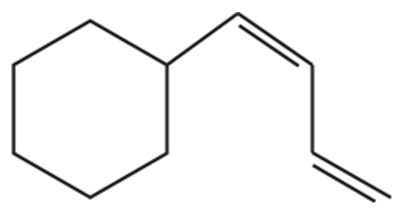
What bromo-substituted compound would be required to react with (CH2=CH)2CuLi in order to form each of the following compounds?
c.

Verified step by step guidance
1
Step 1: Analyze the target compound provided in the image. The structure shows a branched alkane with a total of six carbon atoms, including a methyl group attached to the second carbon of the main chain.
Step 2: Understand the reaction mechanism. The reagent (CH2=CH)2CuLi is a Gilman reagent, which is commonly used for coupling reactions with alkyl halides. It replaces the halide group with an alkyl group derived from the Gilman reagent.
Step 3: Determine the bromo-substituted compound required. To form the target compound, the Gilman reagent will add a vinyl group (CH2=CH-) to the carbon where the bromine atom is located in the starting material.
Step 4: Identify the position of the vinyl group in the target compound. In the target structure, the vinyl group is attached to the second carbon of the main chain. Therefore, the bromo-substituted compound must have a bromine atom at this position.
Step 5: Write the structure of the required bromo-substituted compound. The starting material should be 2-bromo-3-methylpentane, as the bromine atom is located on the second carbon, allowing the Gilman reagent to replace it with the vinyl group.

Verified video answer for a similar problem:

This video solution was recommended by our tutors as helpful for the problem above.
Video duration:
1m
Was this helpful?

Key Concepts

Here are the essential concepts you must grasp in order to answer the question correctly.

Bromo-Substituted Compounds

Bromo-substituted compounds are organic molecules that contain a bromine atom attached to a carbon chain. The presence of the bromine atom makes these compounds reactive, particularly in nucleophilic substitution reactions. Understanding the structure and reactivity of these compounds is crucial for predicting the products of reactions involving them.
Recommended video:
Guided course
01:40
Defining meso compounds.

Organocuprate Reagents

Organocuprate reagents, such as (CH2=CH)2CuLi, are organometallic compounds that contain a copper atom bonded to an organic group. They are known for their ability to act as nucleophiles in organic reactions, particularly in the addition to electrophiles. Their reactivity allows them to form new carbon-carbon bonds, making them valuable in synthetic organic chemistry.
Recommended video:

Nucleophilic Substitution Reactions

Nucleophilic substitution reactions involve the replacement of a leaving group (like bromine) in a molecule with a nucleophile. This type of reaction is fundamental in organic chemistry, as it allows for the transformation of one functional group into another. The mechanism can vary, typically classified as either SN1 or SN2, depending on the structure of the substrate and the conditions of the reaction.
Recommended video:
Guided course
01:47
Nucleophiles and Electrophiles can react in Substitution Reactions.