Ch. 7 - Structure and Synthesis of Alkenes; Elimination
Wade - Organic Chemistry 9th Edition
Wade9th EditionOrganic ChemistryISBN: 9780135213728Not the one you use?Change textbook
Chapter 7, Problem 40g,h

Draw a structure for each compound (includes old and new names).
g. vinylcyclopropane
h. (Z)-2-bromo-2-pentene

Verified step by step guidance
1
Identify the structure of vinylcyclopropane: The term 'vinyl' refers to the presence of an ethenyl group, which is a two-carbon chain with a double bond (CH2=CH-). Cyclopropane is a three-membered carbon ring. Combine these to form vinylcyclopropane by attaching the ethenyl group to the cyclopropane ring.
Draw the cyclopropane ring: Start by sketching a triangle to represent the three-membered ring, which consists of three carbon atoms.
Attach the vinyl group to the cyclopropane: Connect the ethenyl group (CH2=CH-) to one of the carbon atoms in the cyclopropane ring. This forms the structure of vinylcyclopropane.
Identify the structure of (Z)-2-bromo-2-pentene: The 'Z' configuration indicates that the higher priority groups on each carbon of the double bond are on the same side. The compound is a five-carbon chain (pentene) with a double bond at the second carbon and a bromine atom also attached to the second carbon.
Draw the structure of (Z)-2-bromo-2-pentene: Start with a five-carbon chain. Place a double bond between the second and third carbon atoms. Attach a bromine atom to the second carbon. Ensure that the higher priority groups (bromine and the longer carbon chain) are on the same side of the double bond to reflect the 'Z' configuration.

Verified video answer for a similar problem:

This video solution was recommended by our tutors as helpful for the problem above.
Video duration:
4m
Was this helpful?

Key Concepts

Here are the essential concepts you must grasp in order to answer the question correctly.

IUPAC Nomenclature

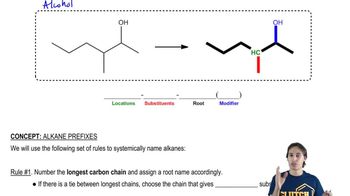
IUPAC nomenclature is a standardized system for naming chemical compounds. It involves identifying the longest carbon chain, numbering the chain to give substituents the lowest possible numbers, and using prefixes and suffixes to denote functional groups and structural features. Understanding this system is crucial for accurately drawing and naming organic compounds.
Recommended video:
Guided course
03:43
The different parts of an IUPAC name

Alkene Geometry

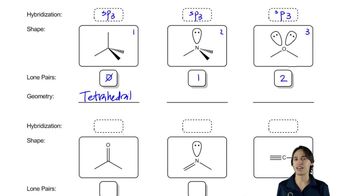
Alkene geometry refers to the spatial arrangement of atoms around the double bond in alkenes, which can be either cis (Z) or trans (E). The (Z) designation indicates that the highest priority groups on each carbon of the double bond are on the same side, affecting the compound's physical and chemical properties. Recognizing these configurations is essential for drawing accurate structures.
Recommended video:
Guided course
07:44
Molecular Geometry Explained.

Cycloalkanes

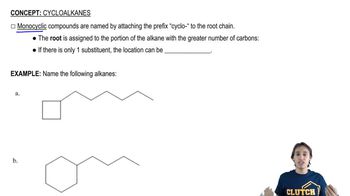
Cycloalkanes are saturated hydrocarbons with carbon atoms arranged in a ring structure. Cyclopropane, a three-membered ring, is a common example. Understanding the stability and strain associated with these rings helps in visualizing and drawing their structures, especially when combined with other functional groups like alkenes, as in vinylcyclopropane.
Recommended video:
Guided course
01:11
How to find the root name for cycloalkanes