Ch. 20 - The Organic Chemistry of Carbohydrates
Bruice - Organic Chemistry 8th Edition
Bruice8th EditionOrganic ChemistryISBN: 9780135213711Not the one you use?Change textbook
Chapter 21, Problem 19b

4-Hydroxy- and 5-hydroxyaldehydes exist primarily as cyclic hemiacetals. Draw the structure of the cyclic hemiacetal formed by each of the following:
b. 4-hydroxypentanal

Verified step by step guidance
1
Identify the functional groups in 4-hydroxypentanal: it contains both an aldehyde (-CHO) group and a hydroxyl (-OH) group. The aldehyde is at the terminal carbon (C1), and the hydroxyl group is on the fourth carbon (C4).
Understand the concept of hemiacetal formation: A hemiacetal is formed when an alcohol group (-OH) reacts with an aldehyde group (-CHO) within the same molecule, resulting in a cyclic structure. This reaction occurs through nucleophilic attack of the hydroxyl oxygen on the carbonyl carbon.
Count the number of carbons between the hydroxyl group (C4) and the aldehyde group (C1). In 4-hydroxypentanal, there are three carbons between these groups, which allows the molecule to form a five-membered ring (furanose-like structure).
Draw the cyclic hemiacetal structure: The oxygen from the hydroxyl group (C4) will form a bond with the carbonyl carbon (C1). The carbonyl oxygen will become a hydroxyl group (-OH) in the process. Ensure that the ring includes C1, C2, C3, C4, and the oxygen atom.
Add substituents to the ring: Place the hydroxyl group (-OH) on C1 (from the aldehyde) and ensure all other substituents (e.g., hydrogens) are correctly positioned on the ring carbons to maintain proper connectivity and stereochemistry.

Verified video answer for a similar problem:

This video solution was recommended by our tutors as helpful for the problem above.
Video duration:
3m
Was this helpful?

Key Concepts

Here are the essential concepts you must grasp in order to answer the question correctly.

Hemiacetals

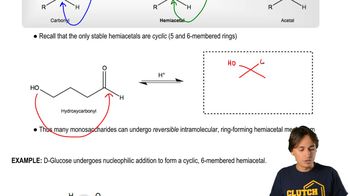
Hemiacetals are organic compounds formed from the reaction of an aldehyde or ketone with an alcohol. In the case of cyclic hemiacetals, this occurs when the hydroxyl group of the alcohol reacts with the carbonyl carbon of the aldehyde, resulting in a ring structure. This transformation is crucial in carbohydrate chemistry, where sugars often exist in cyclic forms.
Recommended video:
Guided course
06:23
Monosaccharides - Forming Cyclic Hemiacetals

Cyclic Structures

Cyclic structures are closed-loop arrangements of atoms in a molecule, which can significantly influence the chemical properties and reactivity of the compound. In the context of hemiacetals, the formation of a cyclic structure stabilizes the molecule and can affect its interactions with other molecules, such as enzymes or receptors in biological systems.
Recommended video:
Guided course
06:23
Monosaccharides - Forming Cyclic Hemiacetals

Hydroxyl Groups

Hydroxyl groups (-OH) are functional groups consisting of an oxygen atom bonded to a hydrogen atom. They are polar and can form hydrogen bonds, which play a vital role in the solubility and reactivity of organic compounds. In the case of 4-hydroxypentanal, the presence of the hydroxyl group is essential for the formation of the cyclic hemiacetal structure.
Recommended video:
Guided course
04:42
Sequence Groups