Ch. 4 - Isomers: The Arrangement of Atoms in Space
Bruice - Organic Chemistry 8th Edition
Bruice8th EditionOrganic ChemistryISBN: 9780135213711Not the one you use?Change textbook
Chapter 5, Problem 4(2)

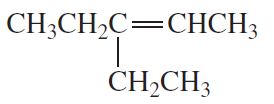
Draw skeletal structures for the compounds in Problem 3, including any cis–trans isomers.
2. Skeletal structure of an alkene with cis and trans isomers, showing carbon chains and double bond configuration.

Verified step by step guidance
1
Identify the compounds mentioned in Problem 3. If the problem refers to specific compounds, ensure you understand their molecular formulas, functional groups, and structural features.
For each compound, determine the main carbon chain (the longest continuous chain of carbon atoms) and identify any substituents or functional groups attached to it.
If the compound contains double bonds, assess whether cis–trans isomerism (geometric isomerism) is possible. This occurs when there are two different groups attached to each carbon of the double bond and the double bond is not at the end of the chain.
Draw the skeletal structure for each compound. Use zigzag lines to represent the carbon chain, omitting hydrogen atoms bonded to carbons for simplicity. Clearly indicate any functional groups or substituents.
For compounds with cis–trans isomerism, draw both the cis isomer (where substituents on the double-bonded carbons are on the same side) and the trans isomer (where substituents are on opposite sides). Label them appropriately.

Verified video answer for a similar problem:

This video solution was recommended by our tutors as helpful for the problem above.
Video duration:
3m
Was this helpful?

Key Concepts

Here are the essential concepts you must grasp in order to answer the question correctly.

Skeletal Structures

Skeletal structures, or line-angle formulas, are simplified representations of organic molecules where carbon atoms are implied at the ends and intersections of lines. This notation omits hydrogen atoms attached to carbons, making it easier to visualize complex molecules. Understanding how to draw and interpret these structures is essential for analyzing organic compounds.
Recommended video:
Guided course
04:03
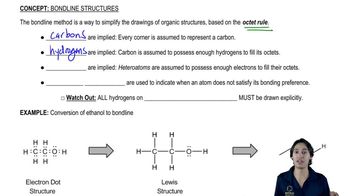
How bondline is different from Lewis Structures.

Cis-Trans Isomerism

Cis-trans isomerism, a type of geometric isomerism, occurs in compounds with restricted rotation around a double bond or a ring structure. In cis isomers, substituents are on the same side, while in trans isomers, they are on opposite sides. Recognizing these configurations is crucial for understanding the physical and chemical properties of the compounds.
Recommended video:
Guided course
00:44
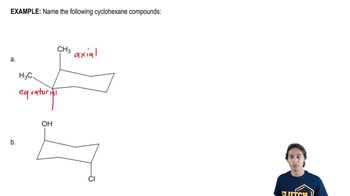
Is the following cyclohexane cis or trans?

Functional Groups

Functional groups are specific groups of atoms within molecules that determine the chemical reactivity and properties of those molecules. Common functional groups include hydroxyl (-OH), carboxyl (-COOH), and amine (-NH2) groups. Identifying functional groups in skeletal structures helps predict the behavior of organic compounds in reactions.
Recommended video:
Guided course
02:36
Identifying Functional Groups