
Ch. 1 - Remembering General Chemistry: Electronic Structure and Bonding (Part 1)
Bruice - Organic Chemistry 8th Edition
Bruice8th EditionOrganic ChemistryISBN: 9780135213711Not the one you use?Change textbook
Chapter 1, Problem 5a

Write the ground-state electronic configuration for chlorine (atomic number 17), bromine (atomic number 35), and iodine (atomic number 53).

Verified step by step guidance
1
Determine the total number of electrons for each element based on their atomic numbers: Chlorine (17 electrons), Bromine (35 electrons), and Iodine (53 electrons).
Recall the order of orbital filling based on the Aufbau principle: 1s, 2s, 2p, 3s, 3p, 4s, 3d, 4p, 5s, 4d, 5p, 6s, 4f, 5d, 6p, etc.
For chlorine (atomic number 17), distribute the electrons into orbitals following the Aufbau principle and Hund's rule: 1s^2 2s^2 2p^6 3s^2 3p^5.
For bromine (atomic number 35), distribute the electrons into orbitals: 1s^2 2s^2 2p^6 3s^2 3p^6 4s^2 3d^{10} 4p^5.
For iodine (atomic number 53), distribute the electrons into orbitals: 1s^2 2s^2 2p^6 3s^2 3p^6 4s^2 3d^{10} 4p^6 5s^2 4d^{10} 5p^5.

Verified video answer for a similar problem:

This video solution was recommended by our tutors as helpful for the problem above.
Video duration:
5m
Was this helpful?

Key Concepts

Here are the essential concepts you must grasp in order to answer the question correctly.

Electron Configuration

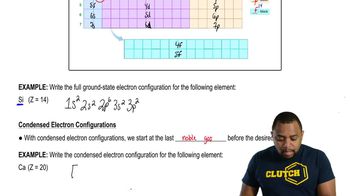
Electron configuration describes the distribution of electrons in an atom's orbitals. It follows the Aufbau principle, which states that electrons fill the lowest energy orbitals first, and is represented using a notation that indicates the energy levels and sublevels occupied by electrons. Understanding this concept is crucial for determining the ground-state configurations of elements.
Recommended video:
Guided course
02:14
The Electron Configuration

Periodic Table and Atomic Number

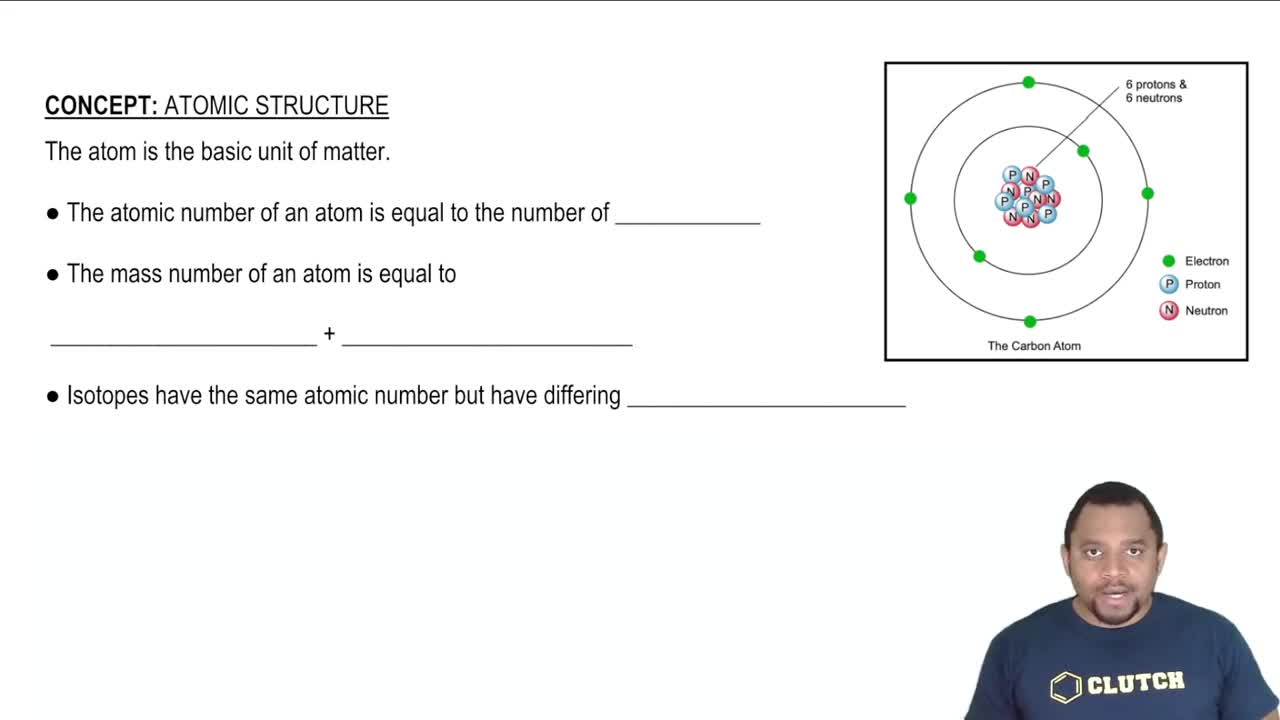
The periodic table organizes elements based on their atomic number, which is the number of protons in the nucleus. This number also indicates the number of electrons in a neutral atom, allowing for the determination of electron configurations. Recognizing the position of elements like chlorine, bromine, and iodine in the periodic table helps in predicting their electron arrangements.
Recommended video:
Guided course
01:44
The difference between atomic numbers and atomic mass.

Valence Electrons

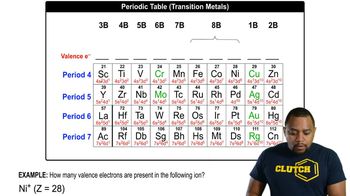
Valence electrons are the outermost electrons of an atom and play a key role in chemical bonding and reactivity. The number of valence electrons can be inferred from the electron configuration and is particularly important for understanding the chemical properties of elements in the same group of the periodic table, such as halogens like chlorine, bromine, and iodine.
Recommended video:
Guided course
03:40
Valence Electrons of Transition Metals