Ch. 19 - Amines
Wade - Organic Chemistry 9th Edition
Wade9th EditionOrganic ChemistryISBN: 9780135213728Not the one you use?Change textbook
Chapter 19, Problem 63c,d

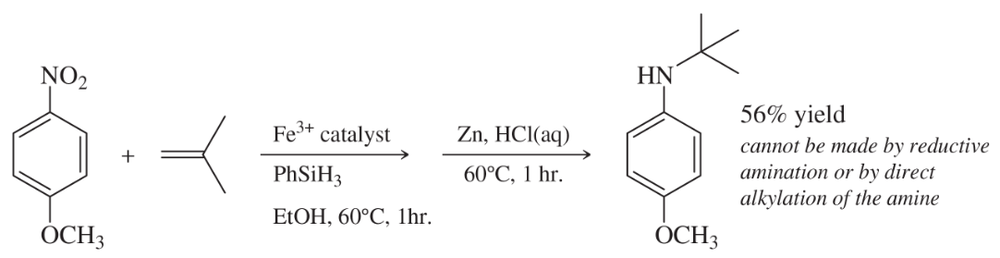
Reductive amination of aldehydes and ketones is a versatile method for attaching alkyl groups to amines, but the alkyl group is restricted to a 1° or 2° carbon by this method. Prof. Phil Baran of Scripps Research Institute has reported (Science, 2015, 348 (6237), 886–891) a novel way to reduce an aromatic nitro group and add the resulting amine to an alkene so that the aromatic amine is bonded to a 3° carbon—all in a continuous sequence of reactions.
For example:

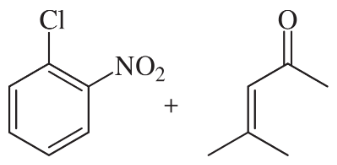
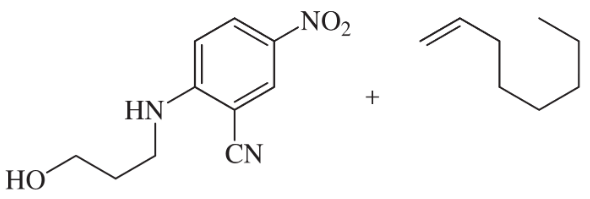
Predict the products using these starting materials, all of which are reported in this paper.
(c)
(d)

Verified step by step guidance
1
Step 1: Analyze the reaction conditions provided in the first image. The reaction involves the reduction of an aromatic nitro group to an amine using Fe³⁺ catalyst and PhSiH₃ in ethanol at 60°C, followed by alkylation of the resulting amine with an alkene in the presence of Zn and HCl(aq). This sequence allows the attachment of the amine to a tertiary carbon.
Step 2: For the second image, identify the starting materials: a nitrobenzene derivative (chloronitrobenzene) and an α,β-unsaturated ketone. The nitro group will be reduced to an amine, and the ketone will likely participate in a conjugate addition reaction with the amine, forming a new C-N bond.
Step 3: For the third image, identify the starting materials: a nitrobenzene derivative with a hydroxyl group and a cyano group, and an alkene. The nitro group will be reduced to an amine, and the alkene will likely undergo a hydroamination reaction, forming a new C-N bond at the tertiary carbon.
Step 4: Predict the intermediate steps for each reaction. In the first step, the nitro group is reduced to an amine. In the second step, the amine reacts with the alkene or α,β-unsaturated ketone to form a new bond at the tertiary carbon. Consider steric and electronic effects that may influence the reaction outcome.
Step 5: Consider the final products for each reaction. The first reaction produces an aromatic amine attached to a tertiary carbon. The second reaction likely forms a β-amino ketone. The third reaction forms an aromatic amine attached to a tertiary carbon, with the hydroxyl and cyano groups remaining intact.

Verified video answer for a similar problem:

This video solution was recommended by our tutors as helpful for the problem above.
Video duration:
2m
Was this helpful?

Key Concepts

Here are the essential concepts you must grasp in order to answer the question correctly.

Reductive Amination

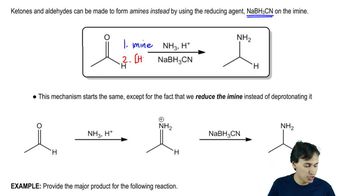
Reductive amination is a chemical reaction that involves the conversion of an aldehyde or ketone into an amine through the formation of an imine intermediate, followed by reduction. This method is particularly useful for attaching alkyl groups to amines, but it is limited to primary and secondary carbon sources due to steric hindrance and reactivity considerations.
Recommended video:
Guided course
07:12
Reductive Amination

Nitro Group Reduction

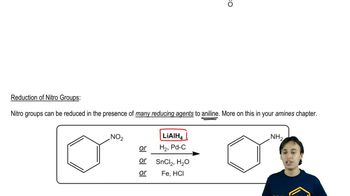
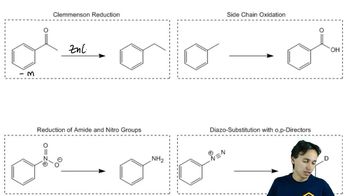
The reduction of nitro groups to amines is a common transformation in organic chemistry, typically achieved using reducing agents such as hydrogen in the presence of a catalyst or chemical reductants like iron or tin. This reaction is significant because it allows for the conversion of aromatic compounds into more reactive amines, which can then participate in further reactions, such as the formation of carbon-carbon bonds.
Recommended video:
Guided course
03:23
Reduction of Nitro Groups

Continuous Reaction Sequences

Continuous reaction sequences involve performing multiple chemical reactions in a single process without isolating intermediates. This approach enhances efficiency and can lead to higher yields of desired products. In the context of the question, it refers to the simultaneous reduction of a nitro group and the addition of the resulting amine to an alkene, allowing for the formation of a tertiary amine in a streamlined manner.
Recommended video:
Guided course
05:04
Sequence Groups
Related Practice
Textbook Question

Show how the substituents containing the azo group (N=N) can facilitate both electrophilic and nucleophilic aromatic substitution.

(a)

1112
views

Textbook Question

Macrolide antibiotics all have large rings (macrocycle) in which an ester makes the ring; a cyclic ester is termed a lactone. One example is erythromycin A, first isolated from soil bacteria in the 1950s. Over time, some pathogenic bacteria have developed resistance to erythromycin by evolving an enzymatic mechanism to cleave the macrocycle at the ketone. To counter this resistance, chemists modified the erythromycin structure to replace the ketone with an amine that the bacteria could not detoxify. This modified antibiotic, azithromycin, trade name Zithromax®, is one of the most prescribed drugs in the world for respiratory infections.

(a) Identify the lactone group in each structure that merits the classification as macrolides.

(b) Two groups are circled. What type of functional group are they? Explain.

698
views
Textbook Question

Show how the substituents containing the azo group (N=N) can facilitate both electrophilic and nucleophilic aromatic substitution.

(b)

784
views
Textbook Question

Basicity depends on availability of an electron pair to bond a proton. Correlate structural effects in these amines with their basicities.

(a) Explain this order:

849
views
Textbook Question

Basicity depends on availability of an electron pair to bond a proton. Correlate structural effects in these amines with their basicities.

(b) Explain:

812
views
Textbook Question

Basicity depends on availability of an electron pair to bond a proton. Correlate structural effects in these amines with their basicities.

(c) The pKb of this compound is −2.3, making it not only a stronger base than a typical aniline, but even stronger than hydroxide ion. Explain its remarkable basicity.

557
views