Ch. 17 - Reactions at the Alpha-Carbon
Bruice - Organic Chemistry 8th Edition
Bruice8th EditionOrganic ChemistryISBN: 9780135213711Not the one you use?Change textbook
Chapter 18, Problem 60a,b

Using cyclopentanone as the reactant, show the product of
b. an aldol addition. 
c. an aldol condensation.

Verified step by step guidance
1
Step 1: Understand the aldol reaction. An aldol addition involves the reaction of an enolate ion (formed from a ketone or aldehyde) with another molecule of ketone or aldehyde to form a β-hydroxy ketone or aldehyde. In an aldol condensation, this β-hydroxy product undergoes dehydration to form an α,β-unsaturated carbonyl compound.
Step 2: Generate the enolate ion from cyclopentanone. Deprotonate the α-hydrogen of cyclopentanone using a base (e.g., hydroxide ion, OH⁻) to form the enolate ion. The enolate ion is resonance-stabilized, with the negative charge delocalized between the oxygen and the α-carbon.
Step 3: Perform the aldol addition. The enolate ion acts as a nucleophile and attacks the carbonyl carbon of another molecule of cyclopentanone. This forms a new C-C bond, resulting in a β-hydroxy ketone intermediate. The structure of this intermediate will have a hydroxyl group (-OH) on the β-carbon relative to the original carbonyl group.
Step 4: For the aldol condensation, dehydrate the β-hydroxy ketone. Under heating or with the presence of a base, the β-hydroxy ketone undergoes elimination of water (dehydration). This forms a double bond between the α and β carbons, resulting in an α,β-unsaturated ketone as the final product.
Step 5: Summarize the products. The aldol addition product is a β-hydroxy ketone, while the aldol condensation product is an α,β-unsaturated ketone. Both reactions start with cyclopentanone as the reactant, and the specific conditions (e.g., base, heat) determine the final product.

Verified video answer for a similar problem:

This video solution was recommended by our tutors as helpful for the problem above.
Video duration:
2m
Was this helpful?

Key Concepts

Here are the essential concepts you must grasp in order to answer the question correctly.

Aldol Addition

Aldol addition is a reaction where two carbonyl compounds, typically aldehydes or ketones, react in the presence of a base to form a β-hydroxy carbonyl compound. In this process, one molecule acts as a nucleophile, attacking the carbonyl carbon of another molecule, leading to the formation of a new carbon-carbon bond. This reaction is crucial for building larger, more complex molecules in organic synthesis.
Recommended video:
Guided course
09:51
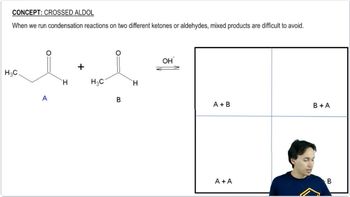
Crossed Aldol

Aldol Condensation

Aldol condensation follows aldol addition and involves the dehydration of the β-hydroxy carbonyl compound formed in the first step. This reaction results in the formation of an α,β-unsaturated carbonyl compound, which is more stable due to resonance. The condensation step typically requires heat and results in the elimination of water, making it an important reaction for creating double bonds in organic compounds.
Recommended video:
Guided course
09:51
Crossed Aldol

Cyclopentanone

Cyclopentanone is a cyclic ketone with the formula C5H8O, featuring a five-membered ring structure. It serves as a versatile reactant in organic reactions, including aldol reactions, due to its carbonyl group, which can participate in nucleophilic addition. Understanding the structure and reactivity of cyclopentanone is essential for predicting the products of aldol addition and condensation reactions involving this compound.
Recommended video:
Guided course
00:21
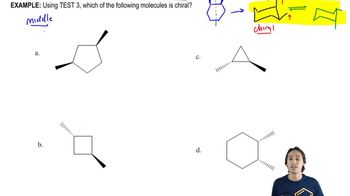
Is the following disubstituted cyclopentane chiral?