Ch. 4 - Acids and Bases: Electron Flow
Mullins - Organic Chemistry: A Learner Centered Approach 1st Edition
Mullins1st EditionOrganic Chemistry: A Learner Centered ApproachISBN: 9780137566471Not the one you use?Change textbook
Chapter 3, Problem 39b

For each indicated proton, suggest an approximate pKa value from Table 4.5. Rationalize your choice.
(b)

Verified step by step guidance
1
Step 1: Identify the type of proton in the molecule. The indicated proton is attached to a carbon that is part of a terminal alkyne group (C≡CH). Terminal alkynes are known to have acidic protons due to the sp-hybridized carbon.
Step 2: Recall the approximate pKa value for terminal alkynes. From Table 4.5 or standard organic chemistry references, terminal alkynes typically have a pKa value around 25.
Step 3: Rationalize the acidity of the proton. The sp-hybridized carbon in the alkyne has 50% s-character, which makes the bond to hydrogen more electronegative and stabilizes the conjugate base (acetylide anion, C≡C⁻) through effective charge delocalization.
Step 4: Compare the acidity of this proton to other functional groups. Terminal alkynes are less acidic than carboxylic acids (pKa ~4-5) but more acidic than alkanes (pKa ~50) and alkenes (pKa ~44). This intermediate acidity is due to the hybridization and stabilization of the conjugate base.
Step 5: Conclude that the approximate pKa value for the indicated proton is around 25, based on the molecular structure and the properties of terminal alkynes.

Verified video answer for a similar problem:

This video solution was recommended by our tutors as helpful for the problem above.
Was this helpful?

Key Concepts

Here are the essential concepts you must grasp in order to answer the question correctly.

pKₐ Value

The pKₐ value is a quantitative measure of the strength of an acid in solution, representing the negative logarithm of the acid dissociation constant (Kₐ). A lower pKₐ indicates a stronger acid, as it dissociates more completely in water. Understanding pKₐ values is crucial for predicting the behavior of acids and bases in chemical reactions.
Recommended video:
Guided course
06:27
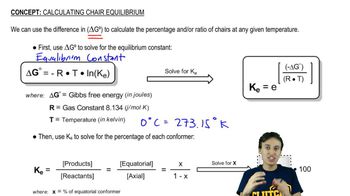
Calculating Chair Equilibrium

Acid-Base Equilibrium

Acid-base equilibrium refers to the balance between the concentrations of acids and their conjugate bases in a solution. This equilibrium is influenced by factors such as pH, temperature, and the presence of other substances. Grasping this concept is essential for rationalizing pKₐ values, as it helps in understanding how protons are transferred and how the strength of acids varies in different environments.
Recommended video:
Guided course
04:00
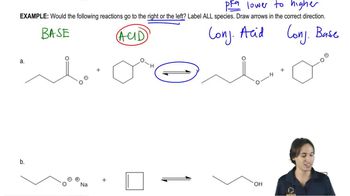
Determining Acid/Base Equilibrium

Structural Effects on Acidity

The acidity of a proton can be significantly affected by the molecular structure of the compound, including electronegativity, resonance, and inductive effects. For instance, the presence of electronegative atoms can stabilize the negative charge of the conjugate base, leading to a lower pKₐ. Recognizing these structural influences is vital for accurately estimating pKₐ values and rationalizing choices based on molecular characteristics.
Recommended video:
1:05
Citric Acid Cycle Structures Concept 1