Ch. 25 - Amines: Structure, Reactions, and Synthesis
Mullins - Organic Chemistry: A Learner Centered Approach 1st Edition
Mullins1st EditionOrganic Chemistry: A Learner Centered ApproachISBN: 9780137566471Not the one you use?Change textbook
Chapter 24, Problem 7a

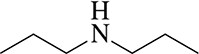
Give an acceptable name for each amine.
(a) Structural formula of an amine with a nitrogen atom bonded to three carbon chains.

Verified step by step guidance
1
Step 1: Identify the structure of the amine. Look for the nitrogen atom and determine how many alkyl or aryl groups are attached to it. Amines are classified as primary (1°), secondary (2°), or tertiary (3°) based on the number of carbon groups attached to the nitrogen.
Step 2: Determine the longest carbon chain attached to the nitrogen atom. This will form the base name of the amine. Use the IUPAC naming system to identify the chain length (e.g., methane, ethane, propane, etc.).
Step 3: Number the carbon chain starting from the end closest to the nitrogen atom. This ensures the nitrogen gets the lowest possible number in the name.
Step 4: Name the substituents attached to the nitrogen atom. If there are additional alkyl groups attached to the nitrogen, use the 'N-' prefix to indicate their position directly bonded to the nitrogen (e.g., N-methyl, N-ethyl).
Step 5: Combine the names of the substituents and the base chain, ensuring proper alphabetical order for substituents. If the amine is cyclic, use the prefix 'cyclo-' and name the ring structure accordingly (e.g., cyclohexylamine).

Verified video answer for a similar problem:

This video solution was recommended by our tutors as helpful for the problem above.
Video duration:
3m
Was this helpful?

Key Concepts

Here are the essential concepts you must grasp in order to answer the question correctly.

Amine Classification

Amines are organic compounds derived from ammonia (NH3) by replacing one or more hydrogen atoms with alkyl or aryl groups. They are classified into primary, secondary, and tertiary amines based on the number of carbon-containing groups attached to the nitrogen atom. Understanding this classification is essential for naming amines correctly.
Recommended video:
Guided course
07:12
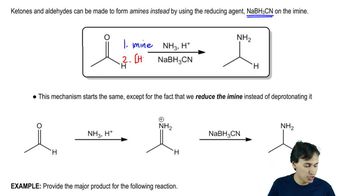
Reductive Amination

IUPAC Nomenclature

The International Union of Pure and Applied Chemistry (IUPAC) provides systematic rules for naming organic compounds, including amines. The naming convention involves identifying the longest carbon chain attached to the nitrogen, using the suffix '-amine' and numbering the chain to give the nitrogen the lowest possible number. Familiarity with these rules is crucial for providing acceptable names for amines.
Recommended video:
Guided course
03:43
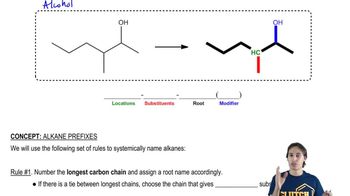
The different parts of an IUPAC name

Functional Groups

Functional groups are specific groups of atoms within molecules that are responsible for the characteristic chemical reactions of those molecules. In the case of amines, the amino group (-NH2) is the functional group that defines their reactivity and properties. Recognizing functional groups helps in understanding the behavior and naming of amines in organic chemistry.
Recommended video:
Guided course
02:36
Identifying Functional Groups