Step 1: Identify the functional group in the molecule. The structure contains a carbonyl group (C=O) directly bonded to a chlorine atom, which classifies it as an acyl chloride.
Step 2: Determine the longest continuous carbon chain that includes the carbonyl carbon. In this case, the longest chain has 5 carbons, making it a pentane derivative.
Step 3: Number the carbon chain starting from the carbonyl carbon (C=O), as it has the highest priority. The carbonyl carbon is assigned position 1.
Step 4: Identify and name the substituents attached to the main chain. There is a methyl group (-CH3) attached to carbon 3.
Step 5: Combine the substituent name, chain name, and functional group suffix. The substituent is named as '3-methyl,' the chain is 'pentane,' and the acyl chloride suffix is '-oyl chloride,' resulting in the name '3-methylpentanoyl chloride.'
Verified video answer for a similar problem:
This video solution was recommended by our tutors as helpful for the problem above
Video duration:
2m
Play a video:
0 Comments
Key Concepts
Here are the essential concepts you must grasp in order to answer the question correctly.
Acid Chlorides
Acid chlorides, also known as acyl chlorides, are organic compounds derived from carboxylic acids by replacing the hydroxyl group (-OH) with a chlorine atom. They are characterized by the functional group -C(=O)Cl and are highly reactive, making them important intermediates in organic synthesis. Acid chlorides can undergo various reactions, including nucleophilic acyl substitution, which is essential for forming esters and amides.
Nomenclature in organic chemistry refers to the systematic naming of chemical compounds based on established rules, primarily those set by the International Union of Pure and Applied Chemistry (IUPAC). For acid chlorides, the naming convention involves identifying the longest carbon chain attached to the carbonyl group, followed by the suffix '-oyl chloride.' Understanding these rules is crucial for accurately naming and communicating about organic compounds.
Functional groups are specific groups of atoms within molecules that are responsible for the characteristic chemical reactions of those molecules. In the case of acid chlorides, the functional group is the acyl chloride (-C(=O)Cl), which influences the compound's reactivity and properties. Recognizing functional groups is essential for predicting the behavior of organic compounds in chemical reactions and for understanding their roles in organic synthesis.

 2:47 minutes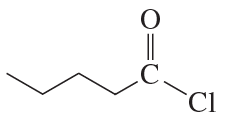
 Verified step by step guidance
 03:13
03:13