Which nucleophile would be more reactive in the solvent given? (a)
Verified step by step guidance
1
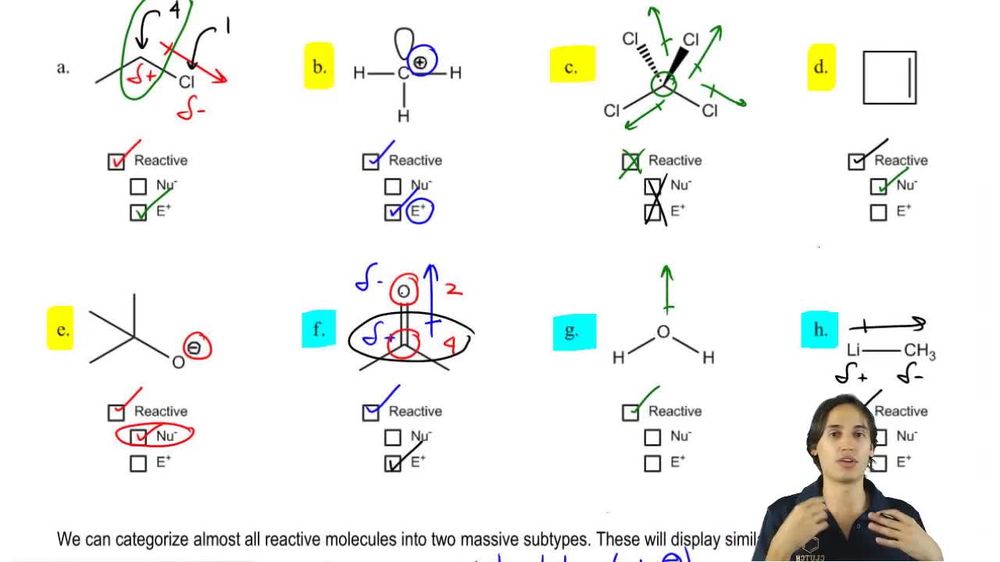
Identify the nucleophiles in the problem. A nucleophile is a species that donates a pair of electrons to form a new covalent bond. Look at the structures provided and determine their electron-rich centers (e.g., lone pairs, negative charges, or π-electrons).
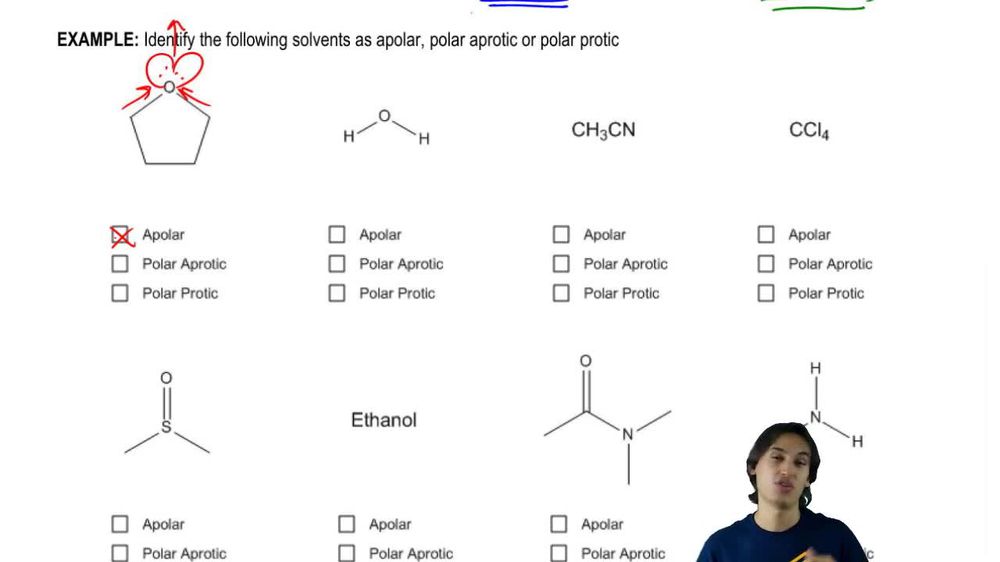
Consider the solvent type. Solvents can be protic (e.g., water, alcohols) or aprotic (e.g., acetone, DMSO). Protic solvents can hydrogen bond with nucleophiles, stabilizing them and reducing their reactivity, while aprotic solvents do not hydrogen bond and allow nucleophiles to remain more reactive.
Evaluate the nucleophiles' basicity and charge. Generally, negatively charged nucleophiles are more reactive than neutral ones, and stronger bases tend to be better nucleophiles in aprotic solvents. However, in protic solvents, smaller nucleophiles may be less reactive due to solvation effects.
Analyze steric hindrance. Bulky nucleophiles are less reactive because their size makes it harder for them to approach the electrophile. Compare the steric profiles of the nucleophiles provided in the problem.
Combine all factors (solvent type, charge, basicity, and steric hindrance) to determine which nucleophile would be more reactive in the given solvent. Use this analysis to make your conclusion.
Verified video answer for a similar problem:
This video solution was recommended by our tutors as helpful for the problem above
Video duration:
2m
Play a video:
0 Comments
Key Concepts
Here are the essential concepts you must grasp in order to answer the question correctly.
Nucleophilicity
Nucleophilicity refers to the ability of a species to donate an electron pair to an electrophile, forming a chemical bond. Factors influencing nucleophilicity include charge, electronegativity, and solvent effects. Generally, negatively charged species are more nucleophilic than their neutral counterparts, and nucleophilicity can vary significantly depending on the solvent used.
The solvent can significantly influence the reactivity of nucleophiles. Polar protic solvents can stabilize nucleophiles through hydrogen bonding, often reducing their reactivity, while polar aprotic solvents can enhance nucleophilicity by not stabilizing the nucleophile as much. Understanding the solvent's nature is crucial for predicting the outcome of nucleophilic reactions.
Electrophilicity is the tendency of a species to accept an electron pair from a nucleophile. Electrophiles are typically electron-deficient and can be positively charged or neutral with a partial positive charge. The strength of an electrophile can affect the reactivity of nucleophiles, as stronger electrophiles will react more readily with nucleophiles.

 2:23 minutes
 Verified step by step guidance
 08:27
08:27