Complete the following chart: The main coenzymes that carry electrons in catabolic pathways are _______ and ________.
Verified step by step guidance
1
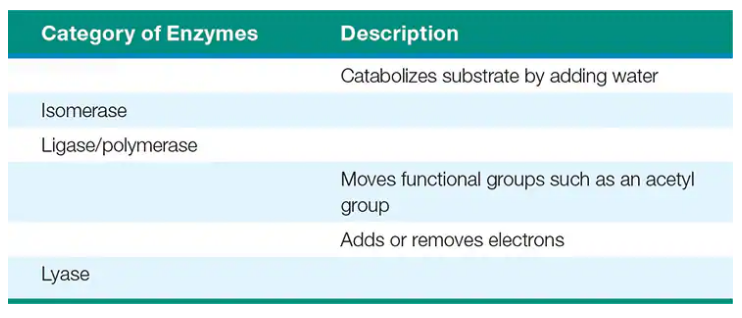
Step 1: Understand the enzyme categories and their functions. The chart lists enzyme categories such as Isomerase, Ligase/polymerase, and Lyase, with some descriptions missing. Begin by recalling the general functions of these enzymes: Isomerases rearrange molecules, Ligases/polymerases join molecules, and Lyases add or remove groups without hydrolysis.
Step 2: Fill in the missing descriptions based on enzyme functions. For example, Isomerases catalyze the rearrangement of atoms within a molecule, so the description could be 'Rearranges atoms within a molecule to form isomers.' Ligases/polymerases catalyze the joining of two molecules, often using ATP, so the description could be 'Joins two molecules together, often requiring energy from ATP.'
Step 3: Identify the enzyme that 'catabolizes substrate by adding water.' This description corresponds to Hydrolases, which catalyze hydrolysis reactions. This category should be added to the chart with the description 'Catabolizes substrate by adding water.'
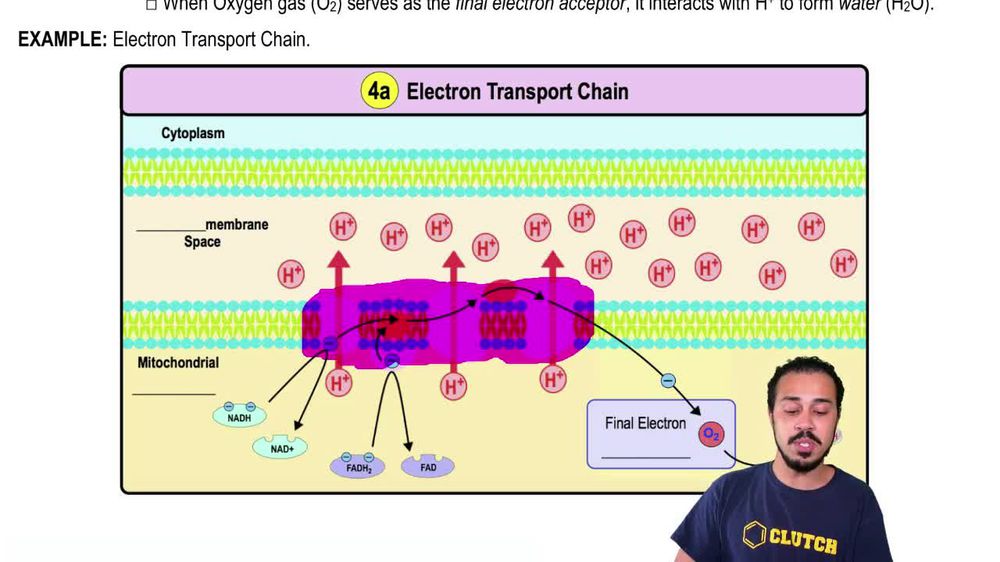
Step 4: Recognize that the main coenzymes carrying electrons in catabolic pathways are NAD+ (nicotinamide adenine dinucleotide) and FAD (flavin adenine dinucleotide). These coenzymes accept electrons during oxidation reactions and are essential in energy metabolism.
Step 5: Complete the sentence by filling in the blanks with the names of these coenzymes: 'The main coenzymes that carry electrons in catabolic pathways are NAD+ and FAD.' This completes the understanding of electron carriers in catabolic reactions.
Verified video answer for a similar problem:
This video solution was recommended by our tutors as helpful for the problem above
Video duration:
2m
Play a video:
0 Comments
Key Concepts
Here are the essential concepts you must grasp in order to answer the question correctly.
Coenzymes in Electron Transport
Coenzymes such as NAD+ (nicotinamide adenine dinucleotide) and FAD (flavin adenine dinucleotide) play crucial roles in catabolic pathways by carrying electrons from substrates to the electron transport chain. These molecules accept electrons during oxidation reactions, becoming reduced to NADH and FADH2, which then donate electrons to generate ATP.
Enzymes are classified based on the reactions they catalyze. For example, hydrolases add water to break bonds, isomerases rearrange molecules, ligases join molecules, and lyases add or remove groups without hydrolysis. Understanding these categories helps identify enzyme functions in metabolic pathways.
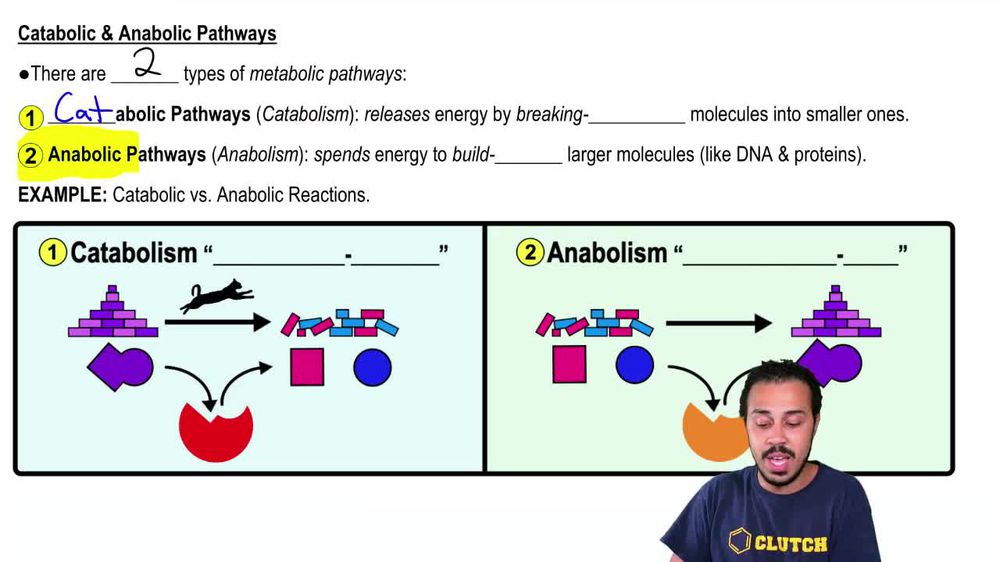
Catabolic pathways break down molecules to release energy, often transferring electrons to coenzymes. This electron transfer is essential for cellular respiration, where energy from electrons is used to produce ATP. Recognizing how electrons move through these pathways clarifies the role of coenzymes and enzymes.