Understand that a chemical element is a fundamental substance that cannot be broken down into simpler substances by chemical means.
Recognize that each chemical element is defined by the number of protons in its atomic nucleus, known as the atomic number.
Know that elements are the building blocks of matter and combine to form compounds through chemical reactions.
Identify that each element has unique properties and is represented by a chemical symbol, such as H for hydrogen or O for oxygen.
Summarize that in microbiology, elements like carbon, nitrogen, and phosphorus are essential for the structure and function of microorganisms.
Verified video answer for a similar problem:
This video solution was recommended by our tutors as helpful for the problem above
Play a video:
0 Comments
Key Concepts
Here are the essential concepts you must grasp in order to answer the question correctly.
Definition of a Chemical Element
A chemical element is a pure substance consisting of only one type of atom, characterized by its unique number of protons in the nucleus, known as the atomic number. Elements cannot be broken down into simpler substances by chemical means.
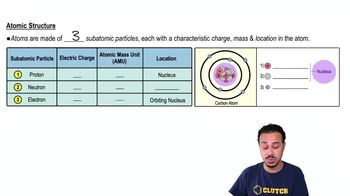
Atoms are the basic units of matter, composed of protons, neutrons, and electrons. The number of protons defines the element, while electrons determine chemical behavior. Understanding atomic structure helps explain why elements have distinct properties.
The periodic table organizes all known chemical elements based on their atomic number and properties. It helps predict element behavior, relationships, and trends, providing a framework for studying chemical elements systematically.

 Verified step by step guidance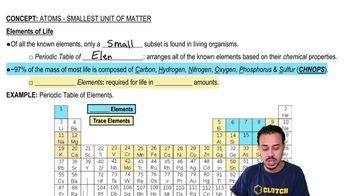
 03:36
03:36