Give several examples of how microbes evade the complement system.
Verified step by step guidance
1
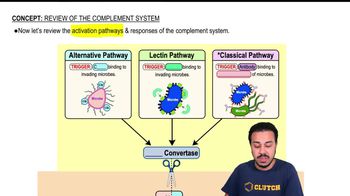
Understand that the complement system is a part of the innate immune response that helps clear pathogens through processes like opsonization, inflammation, and formation of the membrane attack complex (MAC).
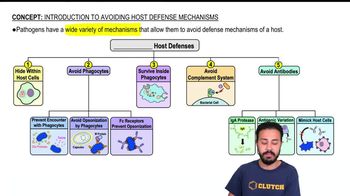
Identify that microbes have evolved various strategies to evade or inhibit the complement system to survive and cause infection.
List examples of microbial evasion mechanisms such as: production of surface proteins that bind and inactivate complement components, secretion of proteases that degrade complement proteins, and expression of capsules that prevent complement activation or deposition.
Explain specific examples, for instance, some bacteria produce proteins like Factor H binding proteins that recruit host regulatory proteins to their surface, thereby inhibiting complement activation.
Mention that some microbes can alter their surface structures to avoid recognition by complement or can produce molecules that mimic host molecules to prevent complement-mediated attack.
Verified video answer for a similar problem:
This video solution was recommended by our tutors as helpful for the problem above
Video duration:
1m
Play a video:
0 Comments
Key Concepts
Here are the essential concepts you must grasp in order to answer the question correctly.
Complement System Overview
The complement system is a group of proteins in the blood that helps clear pathogens by promoting inflammation, opsonization, and cell lysis. It can be activated via classical, lectin, or alternative pathways, leading to the formation of the membrane attack complex that destroys microbial membranes.
Microbes evade the complement system through various strategies such as producing surface proteins that inhibit complement activation, secreting enzymes that degrade complement proteins, or mimicking host molecules to avoid recognition. These tactics help pathogens survive and persist in the host.
Examples include Staphylococcus aureus producing protein A to bind antibodies and prevent complement activation, Neisseria meningitidis expressing factor H binding protein to recruit host regulators, and some bacteria secreting proteases that cleave complement components, thereby blocking the cascade.

 1:36 minutes
 Verified step by step guidance
 05:15
05:15