Ch. 28 - Applied and Industrial Microbiology
Tortora - Microbiology: An Introduction 14th Edition
Tortora14th EditionMicrobiology: An IntroductionISBN: 9780138200398Not the one you use?Change textbook
Chapter 28, Problem 2

How does commercial sterilization differ from sterilization procedures used in a hospital or laboratory?

Verified step by step guidance
1
Understand the definition of sterilization: it is the process of eliminating all forms of microbial life, including spores, from an object or environment.
Recognize that commercial sterilization is primarily used in the food industry to destroy pathogenic microorganisms and spores that can cause food spoilage or foodborne illness, but it may not eliminate all microorganisms.
Note that commercial sterilization aims to achieve a level of microbial destruction sufficient to ensure food safety and shelf stability, often targeting Clostridium botulinum spores specifically.
Contrast this with hospital or laboratory sterilization procedures, which require complete destruction of all microorganisms and spores to prevent infection or contamination, often using methods like autoclaving at higher temperatures and pressures.
Summarize that the key difference lies in the extent and purpose: commercial sterilization is designed to make food safe and shelf-stable without necessarily achieving absolute sterility, whereas hospital and laboratory sterilization aim for total sterility to ensure safety and prevent contamination.

Verified video answer for a similar problem:

This video solution was recommended by our tutors as helpful for the problem above.
Video duration:
1m
Was this helpful?

Key Concepts

Here are the essential concepts you must grasp in order to answer the question correctly.

Commercial Sterilization

Commercial sterilization is a process designed to eliminate all pathogenic microorganisms and spores that can cause food spoilage, ensuring food safety and shelf stability. It typically uses heat treatments like retorting to destroy Clostridium botulinum spores without compromising food quality.
Recommended video:
Guided course
03:17
Commercial Benefits of Microorganisms

Sterilization in Hospitals and Laboratories

Sterilization in hospitals and laboratories aims to completely eliminate all forms of microbial life, including bacteria, viruses, fungi, and spores, to prevent infections and contamination. Methods include autoclaving, dry heat, chemical sterilants, and radiation, ensuring a sterile environment for medical procedures and experiments.
Recommended video:
Guided course
05:58
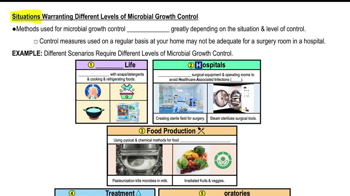
Situations Warranting Different Levels of Microbial Growth Control

Differences in Sterilization Goals and Methods

The main difference lies in the target and intensity: commercial sterilization focuses on food safety by destroying harmful spores while preserving food quality, whereas hospital/lab sterilization requires absolute sterility to prevent infection or contamination. This leads to variations in methods, time, temperature, and validation standards.
Recommended video:
Guided course
05:16
Streak-Plate Method