How might phage conversion provide a bacterium with an evolutionary advantage?
Verified step by step guidance
1
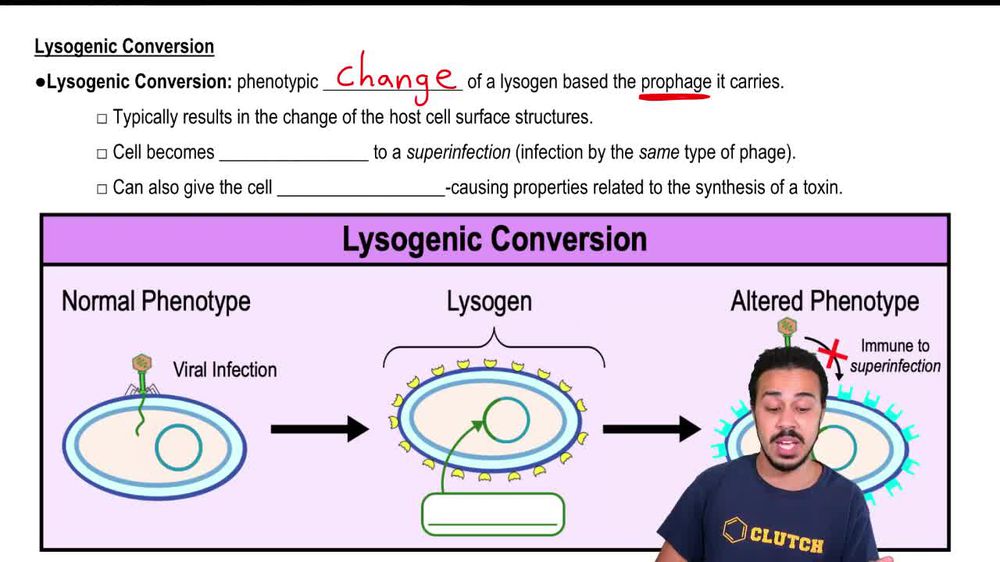
Understand that phage conversion occurs when a bacteriophage (a virus that infects bacteria) integrates its genetic material into the bacterial genome, often bringing new genes to the bacterium.
Recognize that these new genes can encode traits that are beneficial to the bacterium, such as toxin production, antibiotic resistance, or enhanced survival mechanisms.
Consider how these new traits can improve the bacterium's ability to compete in its environment, evade the host immune system, or survive adverse conditions.
Analyze how the acquisition of such advantageous traits through phage conversion can increase the bacterium's fitness, allowing it to reproduce more successfully and spread within a population.
Conclude that phage conversion provides an evolutionary advantage by introducing genetic diversity and novel functions that can enhance bacterial survival and adaptation.
Verified video answer for a similar problem:
This video solution was recommended by our tutors as helpful for the problem above
Video duration:
4m
Play a video:
0 Comments
Key Concepts
Here are the essential concepts you must grasp in order to answer the question correctly.
Phage Conversion
Phage conversion occurs when a bacteriophage integrates its genetic material into a bacterial genome, altering the bacterium's phenotype. This can result in new traits such as toxin production or antibiotic resistance, which were not originally present in the bacterium.
Bacteriophages can undergo lysogenic or lytic cycles. In the lysogenic cycle, the phage DNA integrates into the host genome and replicates with it, potentially transferring beneficial genes to the bacterium, which can enhance survival and adaptation.
An evolutionary advantage allows bacteria to survive, reproduce, and compete better in their environment. Traits gained through phage conversion, like toxin production or resistance, can improve bacterial fitness by helping evade host defenses or outcompete other microbes.

 4:11 minutes
 Verified step by step guidance
 03:37
03:37