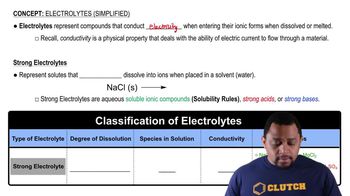
An electrolyte is a substance that produces ions when dissolved in water, allowing the solution to conduct electricity.
Electrolytes can be acids, bases, or salts that dissociate into positive and negative ions in solution.
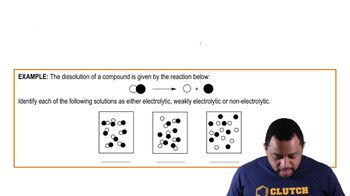
Strong electrolytes dissociate completely in solution, while weak electrolytes only partially dissociate.
Common examples of electrolytes include sodium chloride (NaCl), potassium chloride (KCl), and acetic acid (CH₃COOH).
Electrolytes are crucial for various physiological functions, such as nerve impulse transmission and muscle contraction.
0 Comments
Key Concepts
Here are the essential concepts you must grasp in order to answer the question correctly.
Definition of Electrolytes
Electrolytes are substances that dissociate into ions when dissolved in water, allowing the solution to conduct electricity. Common examples include salts, acids, and bases. The presence of these charged particles is essential for various physiological processes in living organisms.
Electrolytes can be classified into strong and weak electrolytes. Strong electrolytes, like sodium chloride, completely dissociate into ions in solution, while weak electrolytes, such as acetic acid, only partially dissociate. This distinction affects the conductivity and reactivity of the solutions they form.
In biological systems, electrolytes play a crucial role in maintaining fluid balance, transmitting nerve impulses, and muscle contraction. Key electrolytes include sodium, potassium, calcium, and chloride. Imbalances in these ions can lead to serious health issues, highlighting their importance in physiology.