Pearson+ LogoPearson+ Logo
Ch.13 Alkenes, Alkynes, and Aromatic Compounds
McMurry - Fundamentals of GOB 8th Edition
McMurry8th EditionFundamentals of GOBISBN: 9780134015187Not the one you use?Change textbook
Chapter 13, Problem 30a

What do the terms saturated and unsaturated mean?

Verified step by step guidance
1
Understand that the terms 'saturated' and 'unsaturated' are used to describe the types of bonds in organic molecules, particularly hydrocarbons.
Recognize that a 'saturated' hydrocarbon contains only single bonds between carbon atoms. This means each carbon atom is bonded to as many hydrogen atoms as possible, following the general formula C_nH_{2n+2} for alkanes.
Identify that an 'unsaturated' hydrocarbon contains one or more double or triple bonds between carbon atoms. This reduces the number of hydrogen atoms in the molecule compared to a saturated hydrocarbon.
Note that unsaturated hydrocarbons can be further classified into alkenes, which have at least one double bond (C=C), and alkynes, which have at least one triple bond (C≡C).
Remember that the presence of double or triple bonds in unsaturated hydrocarbons affects their chemical reactivity and physical properties, such as boiling and melting points.

Verified video answer for a similar problem:

This video solution was recommended by our tutors as helpful for the problem above.
Was this helpful?

Key Concepts

Here are the essential concepts you must grasp in order to answer the question correctly.

Saturated Compounds

Saturated compounds are organic molecules that contain only single bonds between carbon atoms. This means that each carbon atom is bonded to the maximum number of hydrogen atoms possible, resulting in a structure that is 'saturated' with hydrogen. Common examples include alkanes, such as ethane and propane, which are typically found in fuels and fats.
Recommended video:
Guided course
02:11
Naming Ionic Compounds

Unsaturated Compounds

Unsaturated compounds contain one or more double or triple bonds between carbon atoms, which means they do not hold the maximum number of hydrogen atoms. This results in a more reactive structure compared to saturated compounds. Examples include alkenes, like ethylene, and alkynes, like acetylene, which are important in various chemical reactions and industrial applications.
Recommended video:
Guided course
02:11
Naming Ionic Compounds

Hydrocarbon Structure

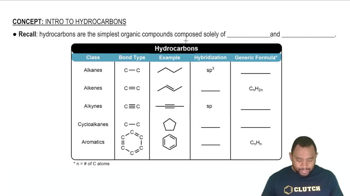
The structure of hydrocarbons, which are compounds made solely of carbon and hydrogen, is fundamental to understanding saturation. Hydrocarbons can be classified as either saturated or unsaturated based on the types of bonds present. This classification affects their physical properties, reactivity, and roles in biological systems, making it essential for fields like organic chemistry and biochemistry.
Recommended video:
Guided course
4:29
Intro to Hydrocarbons Concept 1