The dosage of technetium-99m for a lung scan is 20. µCi/kg of body mass. How many millicuries of technetium-99m should be given to a 50.0-kg person (1 mCi = 1000 µCi)
Ch.5 Nuclear Chemistry
Timberlake13th EditionChemistry: An Introduction to General, Organic, and Biological ChemistryISBN: 9780134421353Not the one you use?Change textbook
Chapter 5, Problem 25
Two technicians in a nuclear laboratory were accidentally exposed to radiation. If one was exposed to 8 mGy and the other to 5 rad, which technician received more radiation?
Verified step by step guidance1
Step 1: Understand the units of radiation exposure. The milligray (mGy) is a unit of absorbed dose in the SI system, while the rad is a unit of absorbed dose in the older CGS system. To compare the two values, they must be converted to the same unit.
Step 2: Recall the conversion factor between rad and gray. 1 rad is equal to 0.01 gray (Gy). Therefore, to convert rad to milligray (mGy), multiply the value in rad by 10, since 1 Gy = 1000 mGy.
Step 3: Convert the exposure of the second technician from rad to mGy. Multiply 5 rad by 10 to find the equivalent dose in mGy.
Step 4: Compare the two values in mGy. The first technician was exposed to 8 mGy, and the second technician's exposure in mGy was calculated in the previous step.
Step 5: Determine which technician received more radiation by comparing the two values. The technician with the higher mGy value received more radiation.

Verified video answer for a similar problem:
This video solution was recommended by our tutors as helpful for the problem above.
Video duration:
1mWas this helpful?
Key Concepts
Here are the essential concepts you must grasp in order to answer the question correctly.
Radiation Dose Units
Radiation exposure is measured in different units, primarily gray (Gy) and rad. One gray is equivalent to 100 rad, making it essential to convert between these units for accurate comparisons. Understanding these units allows for a clear assessment of the radiation dose received by each technician.
Recommended video:
Guided course
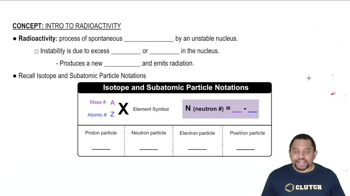
Intro to Radioactivity
Conversion Between Units
To compare the radiation doses of the two technicians, we need to convert the rad measurement to gray. Since 1 rad equals 0.01 Gy, the technician exposed to 5 rad received 0.05 Gy. This conversion is crucial for determining which technician experienced a higher level of radiation exposure.
Recommended video:
Guided course
Conversion Factors (Simplified) Concept 1
Health Effects of Radiation Exposure
Understanding the health implications of radiation exposure is vital. Different doses can lead to varying biological effects, with higher doses posing greater risks. This context helps in evaluating the significance of the exposure levels received by the technicians and the potential need for medical evaluation.
Recommended video:
Guided course
Intro to Radioactivity
Related Practice
Textbook Question
680
views
Textbook Question
Suppose a person absorbed 50 mrad of alpha radiation. What would be the equivalent dose in millisieverts?
1185
views
Textbook Question
Complete each of the following nuclear equations and describe the type of radiation:
e. ? → 8939Y + 0+1e
903
views
Textbook Question
Complete each of the following bombardment reactions:
d. ? + 6428Ni → 272111Rg + 10n
1574
views
Textbook Question
Two samples of a radioisotope were spilled in a nuclear laboratory. The activity of one sample was 8 kBq and the other 15 mCi. Which sample produced the higher amount of radiation?
863
views
Textbook Question
Match each property (1 to 3) with its unit of measurement.
1. activity
2. absorbed dose
3. biological damage
a. rad
842
views