
Textbook Question
The following diagrams represent two similar reactions that have achieved equilibrium:
<IMAGE>
a. Write the expression for the equilibrium constant for each reaction.
1661
views

 Verified step by step guidance
 00:54
00:54
 01:04
01:04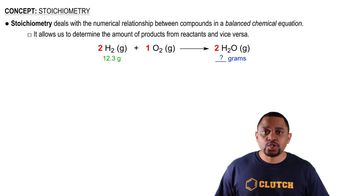 01:16
01:16The following diagrams represent two similar reactions that have achieved equilibrium:
<IMAGE>
a. Write the expression for the equilibrium constant for each reaction.
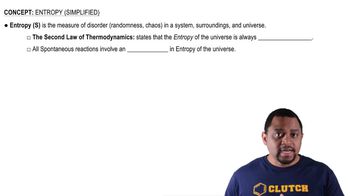
Does entropy increase or decrease in the following processes?
a. Polymeric complex carbohydrates are metabolized by the body, converted into smaller simple sugars.
Do the following reactions favor reactants or products at equilibrium? Give relative concentrations at equilibrium.
a. Sucrose(aq) + H2O(l) ⇌ Glucose(aq) + Fructose(aq) K = 1.4 × 10⁵
The following equation shows the conversion of aluminum oxide (from the ore bauxite) to aluminum:
2 Al2O3(s) → 4 Al(s) + 3 O2(g) ∆H = +801 kcal/mol (+3350 kJ/mol)
c. How many kilocalories are required to produce 10.0 g of aluminum? How many kilojoules?
Do the following reactions favor reactants or products at equilibrium? Give relative concentrations at equilibrium.
c. Fe2O3(s) + 3 CO(g) ⇌ 2 Fe(s) + 3 CO2(g) K (at 727 °C) = 24.2
In photosynthesis, green plants convert carbon dioxide and water into glucose (C6H12O6) according to the following equation:
6 CO2(g) + 6 H2O(l) → C6H12O6(aq) + 6 O2(g)
b. Is the reaction endothermic or exothermic?