Pearson+ LogoPearson+ Logo
Ch.8 Gases, Liquids and Solids
McMurry - Fundamentals of GOB 8th Edition
McMurry8th EditionFundamentals of GOBISBN: 9780134015187Not the one you use?Change textbook
Chapter 8, Problem 86

What is meant by partial pressure?

Verified step by step guidance
1
Partial pressure refers to the pressure exerted by a single gas in a mixture of gases. It is the contribution of that specific gas to the total pressure of the gas mixture.
The concept of partial pressure is based on Dalton's Law of Partial Pressures, which states that the total pressure of a gas mixture is the sum of the partial pressures of all the individual gases in the mixture.
Mathematically, Dalton's Law can be expressed as: Ptotal = P1 + P2 + P3 + ..., where Ptotal is the total pressure and P1, P2, etc., are the partial pressures of the individual gases.
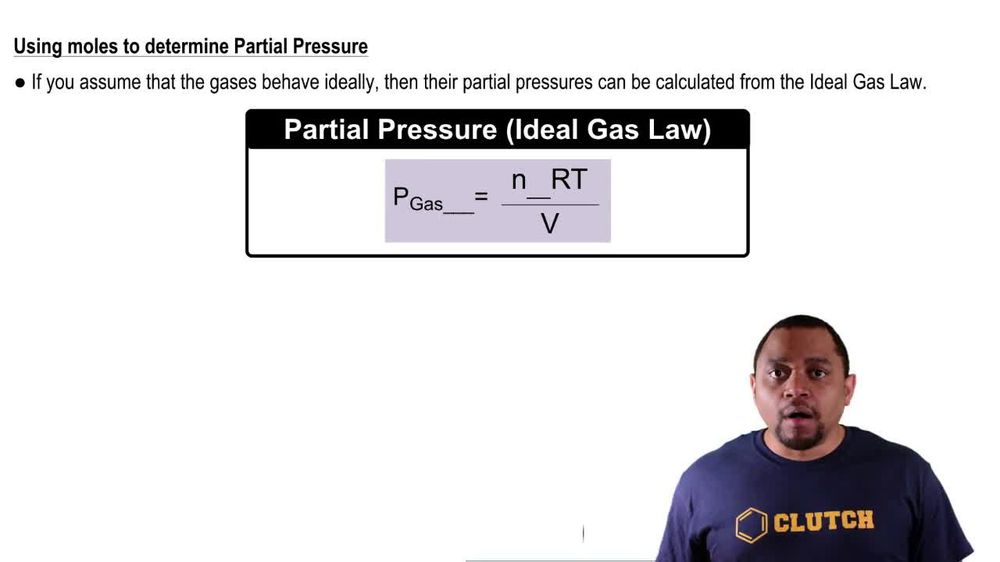
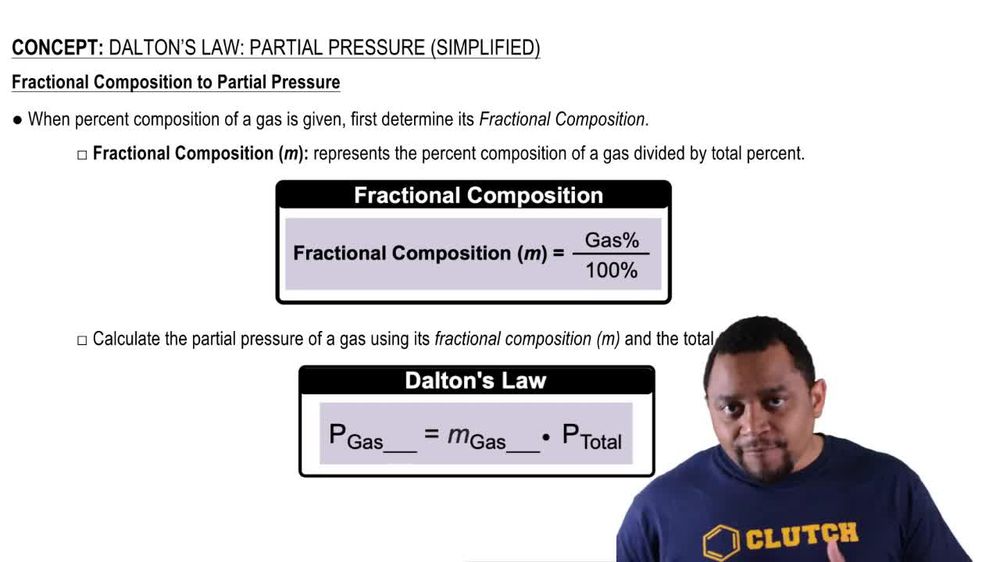
To calculate the partial pressure of a gas, you can use the formula: Pgas = XPtotal, where X is the mole fraction of the gas in the mixture.
Understanding partial pressure is important in various applications, such as gas exchange in the lungs, chemical reactions involving gases, and determining the behavior of gases under different conditions.

Verified video answer for a similar problem:

This video solution was recommended by our tutors as helpful for the problem above.
Video duration:
1m
Was this helpful?

Key Concepts

Here are the essential concepts you must grasp in order to answer the question correctly.

Partial Pressure

Partial pressure refers to the pressure exerted by a single component of a gas mixture. It is a fundamental concept in gas laws, indicating how much pressure a specific gas contributes to the total pressure of the mixture. This concept is crucial for understanding behaviors of gases in various conditions, such as in chemical reactions or biological systems.
Recommended video:
Guided course
00:48
Dalton's Law: Partial Pressure (Simplified) Concept 2

Dalton's Law of Partial Pressures

Dalton's Law states that the total pressure of a gas mixture is equal to the sum of the partial pressures of its individual gases. This principle allows for the calculation of the contribution of each gas in a mixture, facilitating predictions about gas behavior under different conditions. It is essential in fields like chemistry, physics, and environmental science.
Recommended video:
Guided course
01:02
Dalton's Law: Partial Pressure (Simplified) Concept 3

Gas Mixtures

Gas mixtures consist of two or more gases that can interact but maintain their individual properties. Understanding gas mixtures is vital for applications in various scientific fields, including atmospheric science and respiratory physiology. The behavior of these mixtures can be analyzed using concepts like partial pressure and Dalton's Law, which help in predicting how gases will react or behave in different environments.
Recommended video:
Guided course
00:47
Gas Stoichiometry Concept 1