
Textbook Question
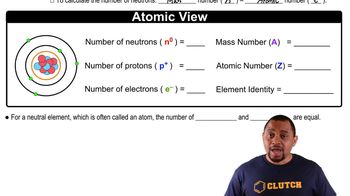
Argon has three naturally occurring isotopes, with mass numbers 36, 38, and 40.
c. How are they different?
1924
views

 Verified step by step guidance
 04:36
04:36
 02:11
02:11 02:52
02:52Argon has three naturally occurring isotopes, with mass numbers 36, 38, and 40.
c. How are they different?
How many protons and electrons are there in a neutral atom of each of the following elements?
a. argon
Indium consists of two isotopes, 11349In and 11549In. If the atomic mass for indium on the periodic table is 114.8, are there more atoms of 11349In or 11549In in a sample of indium?
Argon has three naturally occurring isotopes, with mass numbers 36, 38, and 40.
a. Write the atomic symbol for each of these atoms.
Argon has three naturally occurring isotopes, with mass numbers 36, 38, and 40.
d. Why is the atomic mass of argon listed on the periodic table not a whole number?
Write the atomic symbol for the isotope with each of the following characteristics:
c. 25 electrons and 28 neutrons