Pearson+ LogoPearson+ Logo
Ch.7 Chemical Quantities and Reactions
Timberlake - Chemistry: An Introduction to General, Organic, and Biological Chemistry 13th Edition
Timberlake13th EditionChemistry: An Introduction to General, Organic, and Biological ChemistryISBN: 9780134421353Not the one you use?Change textbook
Chapter 7, Problem 2

What is Avogadro's number?

Verified step by step guidance
1
Avogadro's number is a fundamental constant in chemistry that represents the number of particles (atoms, molecules, or ions) in one mole of a substance.
The value of Avogadro's number is approximately 6.022 × 10^23 particles per mole.
This number is used to relate the macroscopic scale (grams, moles) to the microscopic scale (individual atoms or molecules).
For example, if you have 1 mole of a substance, it contains 6.022 × 10^23 particles of that substance, regardless of whether the particles are atoms, molecules, or ions.
Avogadro's number is named after Amedeo Avogadro, an Italian scientist who contributed to the understanding of the relationship between the number of particles and the amount of substance.

Verified video answer for a similar problem:

This video solution was recommended by our tutors as helpful for the problem above.
Video duration:
1m
Was this helpful?

Key Concepts

Here are the essential concepts you must grasp in order to answer the question correctly.

Avogadro's Number

Avogadro's number, approximately 6.022 x 10^23, is a fundamental constant in chemistry that represents the number of atoms, molecules, or particles in one mole of a substance. It provides a bridge between the atomic scale and macroscopic quantities, allowing chemists to count particles by weighing them.
Recommended video:
Guided course
03:13
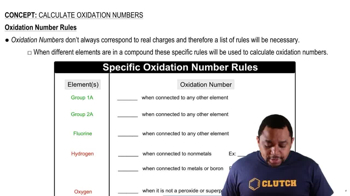
Calculate Oxidation Numbers

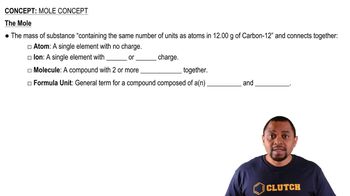
Mole Concept

The mole is a unit of measurement in chemistry that quantifies the amount of substance. One mole contains Avogadro's number of entities, whether they are atoms, molecules, or ions. This concept is essential for stoichiometry, enabling calculations involving reactants and products in chemical reactions.
Recommended video:

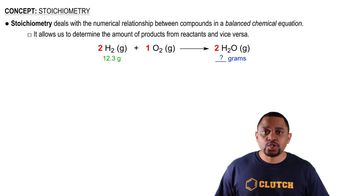
Stoichiometry

Stoichiometry is the area of chemistry that deals with the relationships between the quantities of reactants and products in chemical reactions. It uses the mole concept and Avogadro's number to calculate how much of each substance is needed or produced, ensuring that reactions are balanced and efficient.
Recommended video:
Guided course
01:16
Stoichiometry