
In Problem 6.40, hydrazine reacted with oxygen according to the following (unbalanced) equation: N2H4(l) + O2(g) → NO2(g) + H2O(g)
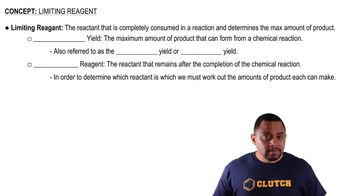
a. If 75.0 kg of hydrazine are reacted with 75.0 kg of oxygen, which is the limiting reagent?
Verified step by step guidance
In Problem 6.40, hydrazine reacted with oxygen according to the following (unbalanced) equation: N2H4(l) + O2(g) → NO2(g) + H2O(g)
a. If 75.0 kg of hydrazine are reacted with 75.0 kg of oxygen, which is the limiting reagent?
Nitrobenzene (C6H5NO2) is used in small quantities as a flavoring agent or in perfumes but can be toxic in large amounts. It is produced by reaction of benzene (C6H6) with nitric acid:
C6H6(l) + HNO3(aq) → C6H5NO2(l) + H2O(l)
b. Calculate the theoretical yield for this reaction.
Titanium metal is obtained from the mineral rutile, TiO2. The process requires multiple steps, as shown in the following reactions:
TiO2(s) + 2 Cl2(g) + 2 C(s) → TiCl4(s) + 2 CO(g)
TiCl4(s) + 2 Mg(s) → Ti(s) + 2 MgCl2(s)
c. How many kilograms of rutile are needed to produce 95 kg of Ti?
When table sugar (sucrose, C12H22O11) is heated, it decomposes to form C and H2O.
b. How many grams of carbon are formed by the breakdown of 60.0 g of sucrose?
When table sugar (sucrose, C12H22O11) is heated, it decomposes to form C and H2O.
a. Write a balanced equation for the process.
Titanium metal is obtained from the mineral rutile, TiO2. The process requires multiple steps, as shown in the following reactions:
TiO2(s) + 2 Cl2(g) + 2 C(s) → TiCl4(s) + 2 CO(g)
TiCl4(s) + 2 Mg(s) → Ti(s) + 2 MgCl2(s)
b. How many moles of TiO2 are needed to form one mole of titanium?