
Textbook Question
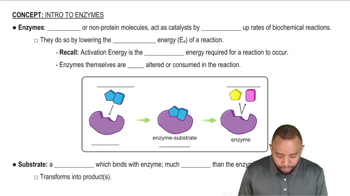
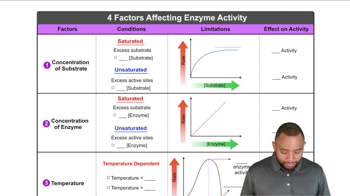
How does an irreversible inhibitor function differently than a reversible inhibitor?
1041
views
 Verified step by step guidance
 2:14
2:14
 5:33
5:33 01:37
01:37How does an irreversible inhibitor function differently than a reversible inhibitor?
Insulin is a protein hormone that functions as two polypeptide chains whose amino acid sequences are as follows:
A chain: GIVEQCCTSICSLTQLENYCN
B chain: FVNQHLCGDHLVEALYLV CGERGFFYTPKT
b. Considering the amino acid sequences, suggest how these two polypeptide chains might be held together in an active insulin molecule.
If each of the following amino acid side chains is present in the active site of an enzyme, indicate whether it would (a) serve a catalytic function, (b) serve to hold the substrate, or (c) both.
d. lysine
Pepsin, an enzyme that hydrolyzes peptide bonds in proteins, functions in the stomach at a pH optimum of 1.5 to 2.0. How is the rate of a pepsin-catalyzed reaction affected by each of the following conditions?
c. running the reaction at 0 °C
Pepsin, an enzyme that hydrolyzes peptide bonds in proteins, functions in the stomach at a pH optimum of 1.5 to 2.0. How is the rate of a pepsin-catalyzed reaction affected by each of the following conditions?
a. increasing the concentration of proteins
Meats spoil due to the action of enzymes that degrade the proteins. Fresh meats can be preserved for long periods of time by freezing them. Explain how freezing meats works to prevent spoilage.