Pearson+ LogoPearson+ Logo
Ch.26 Nucleic Acids and Protein Synthesis
McMurry - Fundamentals of GOB 8th Edition
McMurry8th EditionFundamentals of GOBISBN: 9780134015187Not the one you use?Change textbook
Chapter 26, Problem 5a

Write the full name of:
a. dUMP

Verified step by step guidance
1
Step 1: Understand the abbreviation 'dUMP'. It stands for deoxyuridine monophosphate, which is a nucleotide. Nucleotides are the building blocks of nucleic acids like DNA and RNA.
Step 2: Break down the abbreviation: 'd' stands for 'deoxy', indicating the absence of an oxygen atom on the sugar component of the nucleotide. 'U' stands for 'uridine', which is the nucleoside formed by the base uracil attached to a ribose sugar. 'MP' stands for 'monophosphate', indicating the presence of a single phosphate group.
Step 3: Combine the components to form the full name: 'deoxyuridine monophosphate'. This name reflects the structure of the molecule, which includes a deoxyribose sugar, the base uracil, and one phosphate group.
Step 4: Note that dUMP is an intermediate in the synthesis of thymidine nucleotides, which are essential for DNA replication and repair.
Step 5: If needed, review the structure of dUMP to understand how the components (deoxyribose, uracil, and phosphate) are connected. This can help reinforce the naming conventions used in biochemistry.

Verified video answer for a similar problem:

This video solution was recommended by our tutors as helpful for the problem above.
Video duration:
6m
Was this helpful?

Key Concepts

Here are the essential concepts you must grasp in order to answer the question correctly.

dUMP

dUMP stands for deoxyuridine monophosphate, which is a nucleotide that plays a crucial role in the synthesis of DNA. It is formed from the dephosphorylation of dUTP (deoxyuridine triphosphate) and is a key intermediate in the pathway for the synthesis of thymidine, an essential component of DNA.
Recommended video:
Guided course
04:38
Solubility: Temperature Effect Concept 1

Nucleotide Structure

Nucleotides, the building blocks of nucleic acids, consist of three components: a nitrogenous base, a sugar (deoxyribose in DNA), and a phosphate group. Understanding the structure of nucleotides is essential for grasping how they link together to form DNA and RNA, and how modifications to these structures can affect genetic processes.
Recommended video:
Guided course
1:19
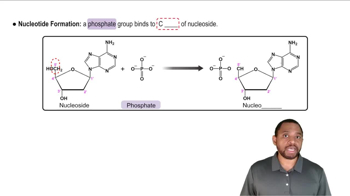
Nucleoside and Nucleotide Formation Concept 2

DNA Synthesis

DNA synthesis is the biological process by which new DNA molecules are formed. This process involves the replication of DNA during cell division and the repair of damaged DNA. Key enzymes, such as DNA polymerases, utilize nucleotides like dUMP to build new strands of DNA, ensuring genetic information is accurately passed on.
Recommended video:
Guided course
1:54
Overview of Protein Synthesis Concept 1