Pearson+ LogoPearson+ Logo
Ch.26 Nucleic Acids and Protein Synthesis
McMurry - Fundamentals of GOB 8th Edition
McMurry8th EditionFundamentals of GOBISBN: 9780134015187Not the one you use?Change textbook
Chapter 26, Problem 42a

What is meant by the term base pairing?

Verified step by step guidance
1
Base pairing refers to the specific hydrogen bonding between complementary nitrogenous bases in nucleic acids, such as DNA and RNA.
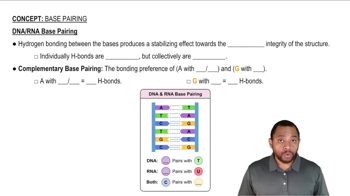
In DNA, the base pairing follows Chargaff's rules, where adenine (A) pairs with thymine (T) through two hydrogen bonds, and cytosine (C) pairs with guanine (G) through three hydrogen bonds.
In RNA, the base pairing is slightly different because thymine (T) is replaced by uracil (U). Therefore, adenine (A) pairs with uracil (U) in RNA, while cytosine (C) still pairs with guanine (G).
Base pairing is crucial for the double-helix structure of DNA, as it ensures the strands are complementary and allows for accurate replication and transcription processes.
The specificity of base pairing is due to the size, shape, and hydrogen bonding capabilities of the nitrogenous bases, ensuring stability and fidelity in genetic information storage and transfer.

Verified video answer for a similar problem:

This video solution was recommended by our tutors as helpful for the problem above.
Video duration:
4m
Was this helpful?

Key Concepts

Here are the essential concepts you must grasp in order to answer the question correctly.

Base Pairing

Base pairing refers to the specific hydrogen bonding between nucleotide bases in DNA and RNA. In DNA, adenine pairs with thymine (A-T) and cytosine pairs with guanine (C-G), while in RNA, adenine pairs with uracil (A-U). This complementary pairing is crucial for the structure of nucleic acids and ensures accurate replication and transcription of genetic information.
Recommended video:
Guided course
2:56
Base Pairing Concept 1

Nucleotide Structure

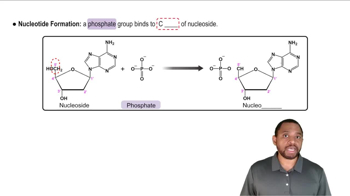
Nucleotides are the building blocks of nucleic acids, consisting of a sugar, a phosphate group, and a nitrogenous base. The sequence of these bases encodes genetic information, and their arrangement determines the specific base pairing that occurs. Understanding nucleotide structure is essential for grasping how base pairing functions in the context of DNA and RNA.
Recommended video:
Guided course
1:19
Nucleoside and Nucleotide Formation Concept 2

Complementarity

Complementarity is the principle that explains how specific base pairs align with one another due to their unique shapes and chemical properties. This concept is fundamental to the stability of the DNA double helix and the accurate pairing during DNA replication and RNA synthesis. It ensures that genetic information is preserved and correctly expressed in living organisms.
Recommended video:
Guided course
2:23
Types of RNA Concept 2