What two factors affect the spontaneity of a reaction?
Ch.7 Chemical Reactions: Energy, Rate and Equilibrium
McMurry8th EditionFundamentals of General, Organic, and Biological ChemistryISBN: 9780134015187Not the one you use?Change textbook
Chapter 7, Problem 32a
For each of the following processes, specify whether entropy increases or decreases. Explain each of your answers.
a. Assembling a jigsaw puzzle
Verified step by step guidance1
Understand the concept of entropy: Entropy is a measure of the disorder or randomness in a system. Processes that increase disorder result in an increase in entropy, while processes that create more order result in a decrease in entropy.
Analyze the process described: Assembling a jigsaw puzzle involves taking individual, disordered pieces and arranging them into a single, ordered picture.
Relate the process to entropy: Since the pieces of the puzzle are initially in a disordered state and the process of assembling them creates a more ordered state, the overall disorder of the system decreases.
Determine the change in entropy: A decrease in disorder corresponds to a decrease in entropy for this process.
Conclude: The entropy decreases when assembling a jigsaw puzzle because the system becomes more ordered as the pieces are put together.

Verified video answer for a similar problem:
This video solution was recommended by our tutors as helpful for the problem above.
Video duration:
1mWas this helpful?
Key Concepts
Here are the essential concepts you must grasp in order to answer the question correctly.
Entropy
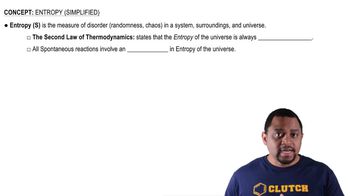
Entropy is a measure of disorder or randomness in a system. In thermodynamics, it quantifies the number of microscopic configurations that correspond to a thermodynamic system's macroscopic state. Higher entropy indicates greater disorder, while lower entropy suggests more order. Understanding entropy is crucial for analyzing processes in terms of energy dispersal and system organization.
Recommended video:
Guided course
Entropy (Simplified) Concept 1
Order vs. Disorder
The concepts of order and disorder are fundamental to understanding entropy. A system is considered ordered when its components are arranged in a structured manner, while it is disordered when the arrangement is random. In the context of assembling a jigsaw puzzle, the initial state is disordered, and as pieces are put together, the system becomes more ordered, which affects the overall entropy of the process.
Recommended video:
Guided course
Enantiomers vs Diastereomers Concept 1
Thermodynamic Processes
Thermodynamic processes refer to the transformations that a system undergoes, which can involve changes in energy, temperature, and entropy. These processes can be classified as reversible or irreversible, with irreversible processes typically leading to an increase in entropy. Analyzing the assembly of a jigsaw puzzle as a thermodynamic process helps to illustrate how the transition from disorder to order impacts entropy.
Recommended video:
Guided course
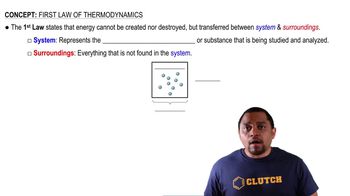
First Law of Thermodynamics
Related Practice
Textbook Question
1985
views
Textbook Question
Which of the following processes results in an increase in entropy of the system?
a. A drop of ink spreading out when it is placed in water
b. Steam condensing into drops on windows
c. Constructing a building from loose bricks
884
views
Textbook Question
What is the difference between an exothermic reaction and an exergonic reaction?
1713
views
Textbook Question
Under what conditions might a reaction be endothermic but exergonic? Explain.
1762
views
Textbook Question
Glucose, also known as "blood sugar" when measured in blood, has the formula C6H12O6.
a. Write the equation for the combustion of glucose with O2 to give CO2 and H2O.
3416
views
Textbook Question
Glucose, also known as "blood sugar" when measured in blood, has the formula C6H12O6.
c. What is the minimum amount of energy (in kJ) a plant must absorb to produce 15.0 g of glucose?
2956
views