
To determine the set of four quantum numbers for the sixth electron of an oxygen atom, we first need to understand the electron configuration of oxygen. With an atomic number of 6, the electron configuration is represented as 1s2 2s2 2p4. This indicates that oxygen has a total of six electrons distributed across its orbitals.
In the electron orbital diagram, we fill the orbitals according to the Aufbau principle, Pauli exclusion principle, and Hund's rule. The filling sequence starts with the 1s orbital, which can hold two electrons (1s2), followed by the 2s orbital (2s2), and then the 2p orbitals. For the 2p orbitals, we first half-fill each of the three available orbitals before pairing up the electrons, resulting in the configuration of 2p4 being filled as follows: up, up, up, down, down.
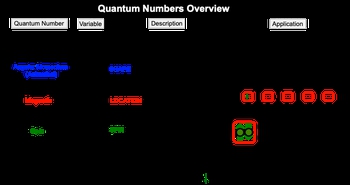
To identify the quantum numbers for the sixth electron, we note its position in the orbital diagram. The sixth electron is the last one added to the 2p orbitals. The relevant quantum numbers are defined as follows:
- Principal quantum number (n): This indicates the energy level of the electron. For the sixth electron in the 2p orbital, n = 2.
- Azimuthal quantum number (l): This describes the subshell of the electron. For a p orbital, l = 1.
- Magnetic quantum number (ml): This specifies the orientation of the orbital. The sixth electron occupies the ml = 0 orbital within the 2p subshell.
- Spin quantum number (ms): This indicates the spin direction of the electron. Since the sixth electron is represented as pointing up, ms = +1/2.
Thus, the complete set of quantum numbers for the sixth electron in an oxygen atom is:
n = 2, l = 1, ml = 0, ms = +1/2.
Understanding these quantum numbers is essential for grasping the behavior of electrons in atoms and their arrangement in various energy levels and subshells.