When performing calculations involving addition and subtraction, it is essential to determine the final answer based on the least number of decimal places among the numbers involved. This principle directly influences the significant figures in the result. For instance, consider the calculation of \( 402.09 - 2.12 + 2.671 \). Here, the numbers have the following decimal places: 402.09 has 2 decimal places, 2.12 has 2 decimal places, and 2.671 has 3 decimal places. Since the least number of decimal places is 2, the final answer must also be rounded to 2 decimal places.Calculating the expression yields \( 402.09 - 2.12 + 2.671 = 402.09 - 2.12 + 2.671 = 402.641 \). Rounding this to 2 decimal places results in \( 402.64 \). In terms of significant figures, the first non-zero digit is counted from left to right. In this case, \( 402.64 \) has 5 significant figures. Therefore, the final answer, considering both decimal places and significant figures, is \( 402.64 \) with 5 significant figures.When mixing operations such as multiplication and division with addition and subtraction, the rules for determining significant figures and decimal places remain crucial. Understanding how to apply these rules ensures accuracy in scientific calculations.
1. Intro to General Chemistry
Significant Figures: In Calculations
1. Intro to General Chemistry
Significant Figures: In Calculations: Videos & Practice Problems
Topic summary
Significant Figures: In Calculations combines significant figures, decimal places, and the order of operations to determine how a final answer should be reported. For multiplication or division, the result is limited by the least number of significant figures among the values used. For addition or subtraction, the result is limited by the least number of decimal places. In scientific notation, sig figs are determined from the coefficient only.
In mixed operations, work step by step using PENDES: parentheses, exponents, multiplication and division, then addition and subtraction. After each step, apply the correct rounding rule for that type of operation before moving on. Exponents represent repeated multiplication, so they follow the multiplication rule for sig figs. This approach prevents carrying too many digits and ensures the final reported value reflects the proper precision.
A key idea is that rounding in one step can affect later steps, especially when addition or subtraction changes the allowed decimal places and therefore the final number of sig figs. Careful use of least sig figs, least decimal places, and order of operations leads to answers that match the precision justified by the original measurements.
Significant Figures are often involved in chemical calculations.
Significant Figures In Calculations
0
Concept
Significant Figures in Addition and Substraction

Video duration:
1mSignificant Figures in Addition and Substraction Video Summary
Study Smarter with Worksheets.
Follow along with each video using our printable worksheets

0
Concept
Significant Figures in Mixed Operations
Video duration:
3mSignificant Figures in Mixed Operations Video Summary
When performing calculations that involve mixed operations such as multiplication, division, addition, and subtraction, it is essential to adhere to the order of operations. A helpful mnemonic for remembering this order is PENDES, which stands for Parentheses, Exponents, Multiplication and Division (from left to right), and Addition and Subtraction (from left to right). This structure ensures that calculations are performed correctly and consistently.
For example, consider the expression 1.89 \(\times\) 10^6 \(\times\) 3.005 and 5.21^3 \(\div\) (8.829 - 6.5 + 2.920). The first step is to evaluate any expressions within parentheses. In this case, we first multiply the numbers in brackets:
1.89 \(\times\) 10^6 \(\times\) 3.005 = 5679450. However, when reporting this result, we must consider significant figures. The number 1.89 \(\times\) 10^6 has 3 significant figures, while 3.005 has 4. Therefore, our final answer should also have 3 significant figures, resulting in 5.68 \(\times\) 10^6 when expressed in scientific notation.
Next, we calculate 5.21^3, which means multiplying 5.21 \(\times\) 5.21 \(\times\) 5.21. The initial result is 141.420761, but since all factors have 3 significant figures, we round this to 141.
Now, we address the subtraction and addition in the denominator: 8.829 - 6.5 + 2.920. The subtraction yields 2.329, which has 3 decimal places, while 2.920 has 3 decimal places as well. Therefore, the final result of this operation must be rounded to 1 decimal place, giving us 2.3.
Next, we add 2.3 + 2.920, which results in 5.220. Since 2.3 has 1 decimal place and 2.920 has 3, the final answer must also have 1 decimal place, resulting in 5.2.
Now, we multiply the results from the numerator and denominator. The multiplication of 5.68 \(\times\) 10^6 and 141 gives 8.0088 \(\times\) 10^8. Since both numbers have 3 significant figures, we round this to 8.01 \(\times\) 10^8.
Finally, we divide 8.01 \(\times\) 10^8 by 5.2. The result is 1.54 \(\times\) 10^8, but since 5.2 has 2 significant figures, we round our final answer to 1.5 \(\times\) 10^8.
In summary, when dealing with mixed operations, always follow the order of operations and apply the rules for significant figures: for multiplication and division, use the least number of significant figures; for addition and subtraction, use the least number of decimal places.
0
Problem
Perform the following calculation to the right number of sig figs:
[(1.7 × 10⁶) ÷ (2.63 × 10⁵)] + 6.96
A
13.46
B
13.0
C
13.5
D
14.2
E
4.471
0
Problem
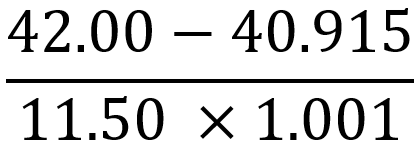
What answer should be reported, with the correct number of significant figures, for the following calculation?
A
0.00822
B
0.0845
C
0.0921
D
0.0947
Do you want more practice?
More setsSignificant Figures: In Calculations
1. Intro to General Chemistry
3 problems
Topic

Jules
1. Intro to General Chemistry - Part 1 of 3
7 topics 8 problems
Chapter

ErnestBlazevic
1. Intro to General Chemistry - Part 2 of 3
5 topics 9 problems
Chapter
Jules
1. Intro to General Chemistry - Part 3 of 3
5 topics 10 problems
Chapter
Jules
Go over this topic definitions with flashcards
More setsHere's what students ask on this topic:
In multiplication and division, the final answer should have the same number of significant figures as the value with the least significant figures in the calculation. To determine this, first count the significant figures in each number. For example, in scientific notation, only the coefficient's significant figures count. After performing the calculation, round the result to match the smallest number of significant figures found among the original values. This ensures the precision of the result reflects the least precise measurement used in the calculation.
When adding or subtracting, the final answer should be rounded to the least number of decimal places among the numbers involved. This means you look at the decimal places, not the total significant figures. For example, if you add 402.09 (two decimal places) and 2.1 (one decimal place), your answer should be rounded to one decimal place. This rule ensures the result does not imply greater precision than the least precise measurement.
For mixed operations involving multiplication, division, addition, and subtraction, follow the order of operations (PENDAS: Parentheses, Exponents, Multiplication/Division, Addition/Subtraction). Apply the significant figure rules at each step: use the least number of significant figures for multiplication/division and the least number of decimal places for addition/subtraction. Perform calculations step-by-step, rounding appropriately after each operation to maintain accuracy and precision throughout the process.
In scientific notation, only the digits in the coefficient (the number before the exponent) count toward significant figures. The exponent does not affect the number of significant figures. For example, in , the coefficient 5.7 has two significant figures, so the number has two significant figures overall. This simplifies counting significant figures in calculations involving very large or very small numbers.
Using the correct number of significant figures ensures that the precision of your calculated results reflects the precision of the measurements used. This is crucial in chemistry because it prevents overestimating the accuracy of results, which can lead to incorrect conclusions. Proper use of significant figures supports reliable interpretation of chemical data in stoichiometry, thermodynamics, and equilibrium calculations, helping maintain scientific integrity and consistency.