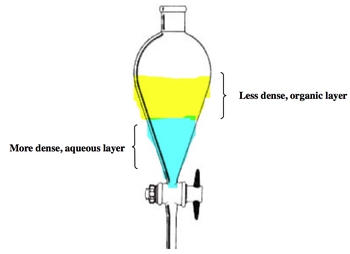

Acid-base extraction is a crucial laboratory technique used to separate compounds based on their acidity and basicity. The process begins with the addition of a weak base before a strong base, which allows for the selective reaction of the most acidic component in a mixture. This strategy ensures that only the strongest acid reacts first, preventing the complete neutralization of all acidic compounds and facilitating their separation.
Understanding the pKa values of the compounds involved is essential, as the lower the pKa, the stronger the acid. For instance, in a mixture containing propane (pKa 60), methylamine (pKa 10.64), phenol, and acetic acid (pKa 4.76), acetic acid is the most acidic and will be the first to react with a weak base like sodium bicarbonate (0.25 M). This reaction converts acetic acid into its acetate ion, which is now negatively charged and soluble in the aqueous layer, allowing for its separation from the organic layer.
Once the most acidic component is removed, the remaining compounds can be treated with a stronger base, such as sodium hydroxide, to extract the next most acidic compound, phenol. This reaction generates the phenolate ion, which also becomes soluble in the aqueous layer. To revert these ions back to their neutral forms, acidified water is used to donate protons (H+), allowing them to precipitate as solids in the aqueous layer.
After isolating phenol, the remaining compounds include propane and methylamine. Propane, being nonpolar, remains in the organic layer. Methylamine, classified as a weak base, reacts with hydrochloric acid (HCl) to form the methylammonium ion, which is positively charged and thus migrates to the aqueous layer. To neutralize this ion, a base is used to remove a proton, allowing it to precipitate as a solid.
This systematic approach to acid-base extraction highlights the importance of understanding the properties of acids and bases, including their pKa and Ka values. A higher Ka indicates a stronger acid, while a lower pKa signifies the same. Mastery of these concepts is vital for effectively performing acid-base extractions and achieving successful separations in organic chemistry.