Skip to main content
General Chemistry
My Course
Learn
Exam Prep
AI Tutor
Study Guides
Textbook Solutions
Flashcards
Explore
My Course
Learn
Exam Prep
AI Tutor
Study Guides
Textbook Solutions
Flashcards
Explore
Back
Temperature definitions
You can tap to flip the card.
Define:
Temperature
You can tap to
flip the card.
👆
Temperature
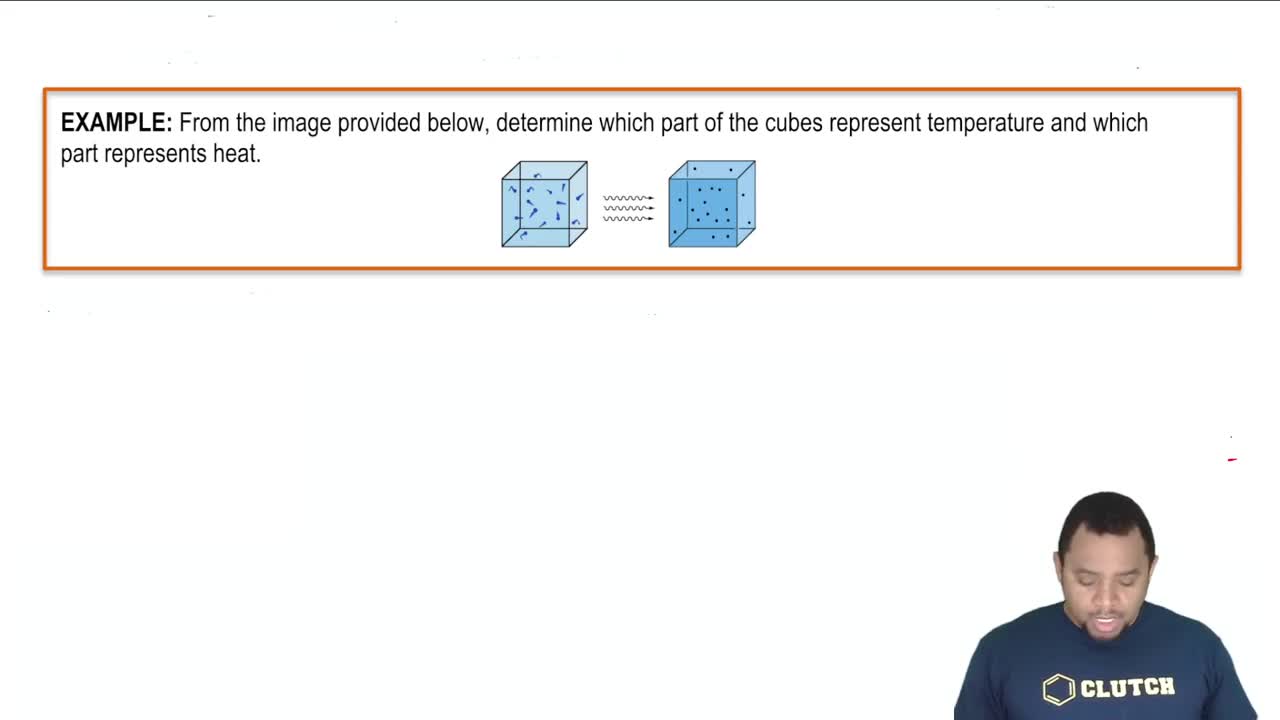
The average kinetic energy of molecules in a substance, measured in Celsius, Fahrenheit, or Kelvin.
Track progress
Control buttons has been changed to "navigation" mode.
1/12
Related flashcards
Related practice
Recommended videos
Guided course
03:48
Temperature vs Heat
Jules
6610
views
92
rank
Guided course
01:14
Heat vs Temperature Example
Jules
7507
views
75
rank
Guided course
02:03
Temperature Conversion Formulas
Jules
7945
views
95
rank
Terms in this set (12)
Hide definitions
Temperature
The average kinetic energy of molecules in a substance, measured in Celsius, Fahrenheit, or Kelvin.
Heat
The transfer of thermal energy from a warmer object to a cooler one, dependent on substance amount.
Thermal Energy
The sum of all kinetic and potential energies of atoms in an object.
Kinetic Energy
The energy of motion, related to the movement of molecules and atoms.
Potential Energy
The energy of position, related to the location of molecules or atoms.
Intensive Property
A property that does not depend on the amount of substance present, like temperature.
Extensive Property
A property that varies with the amount of substance, like heat.
Celsius
A temperature scale where water freezes at 0 degrees and boils at 100 degrees.
Fahrenheit
A temperature scale where water freezes at 32 degrees and boils at 212 degrees.
Kelvin
An absolute temperature scale starting at absolute zero, where 0 K is -273.15°C.
Conversion Formula
Equations used to convert between temperature scales, such as K=°C+273.15.
Thermal Equilibrium
A state where two objects in contact no longer exchange heat, having the same temperature.
 BackBack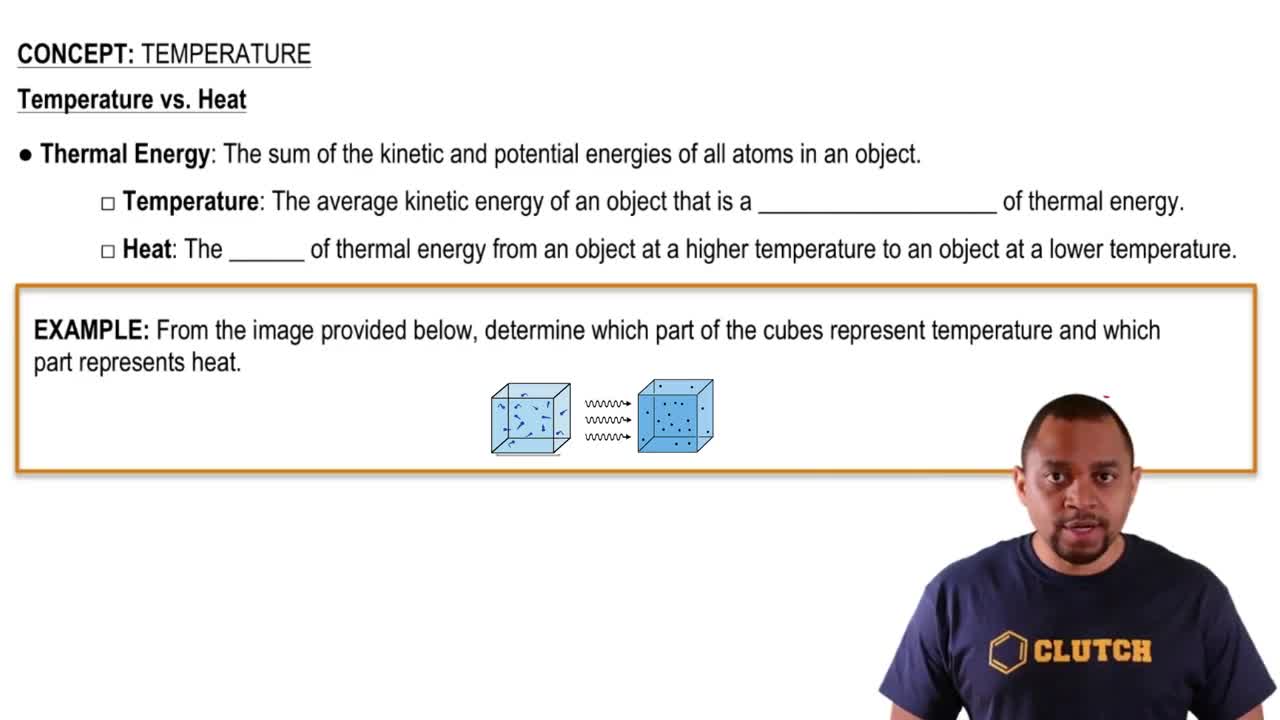
 03:48
03:48