Exercises 53–60 show incomplete graphs of given polynomial functions. a) Find all the zeros of each function. b) Without using a graphing utility, draw a complete graph of the function. f(x)=−x3+x2+16x−16
Ch. 3 - Polynomial and Rational Functions

Chapter 4, Problem 51
Solve each rational inequality in Exercises 43–60 and graph the solution set on a real number line. Express each solution set in interval notation. x/(x−3)>0
Verified step by step guidance1
Identify the critical points by setting the numerator and denominator equal to zero separately. For the numerator: \(x = 0\). For the denominator: \(x - 3 = 0\), so \(x = 3\). These points divide the number line into intervals to test.
Determine the intervals created by the critical points: \((-\infty, 0)\), \((0, 3)\), and \((3, \infty)\). These intervals will be tested to see where the inequality \(\frac{x}{x-3} > 0\) holds true.
Choose a test point from each interval and substitute it into the expression \(\frac{x}{x-3}\). Check the sign (positive or negative) of the result to determine if the inequality is satisfied in that interval.
Remember that the inequality is strict (\(>\) 0), so exclude points where the expression is zero or undefined. Specifically, exclude \(x = 0\) (where numerator is zero) and \(x = 3\) (where denominator is zero and expression is undefined).
Combine the intervals where the expression is positive to write the solution set in interval notation, and then graph these intervals on the real number line, marking excluded points appropriately.

Verified video answer for a similar problem:
This video solution was recommended by our tutors as helpful for the problem above.
Video duration:
5mWas this helpful?
Key Concepts
Here are the essential concepts you must grasp in order to answer the question correctly.
Rational Inequalities
Rational inequalities involve expressions where one polynomial is divided by another, and the inequality compares this ratio to zero or another value. Solving them requires finding where the expression is positive, negative, or zero by analyzing the signs of numerator and denominator.
Recommended video:
Guided course
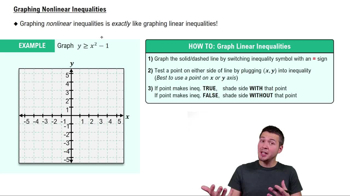
Nonlinear Inequalities
Critical Points and Sign Analysis
Critical points occur where the numerator or denominator equals zero, dividing the number line into intervals. By testing values in each interval, you determine the sign of the rational expression, which helps identify where the inequality holds true.
Recommended video:
Guided course
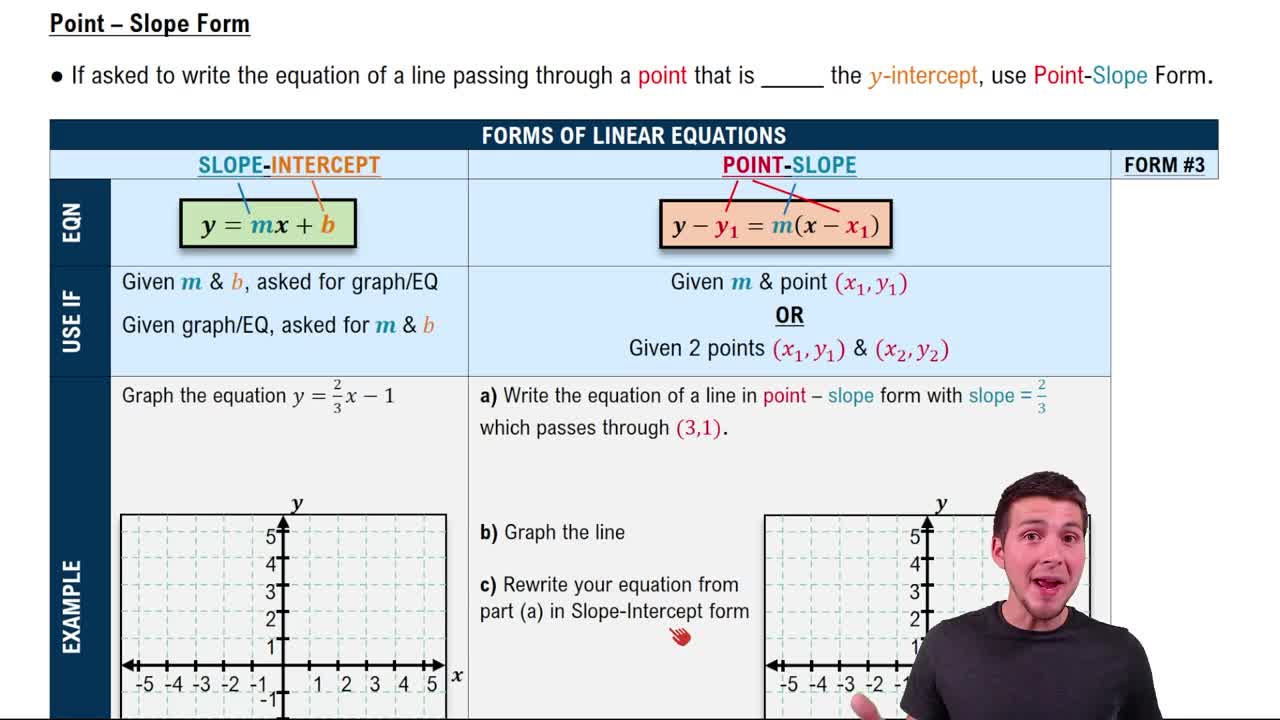
Point-Slope Form
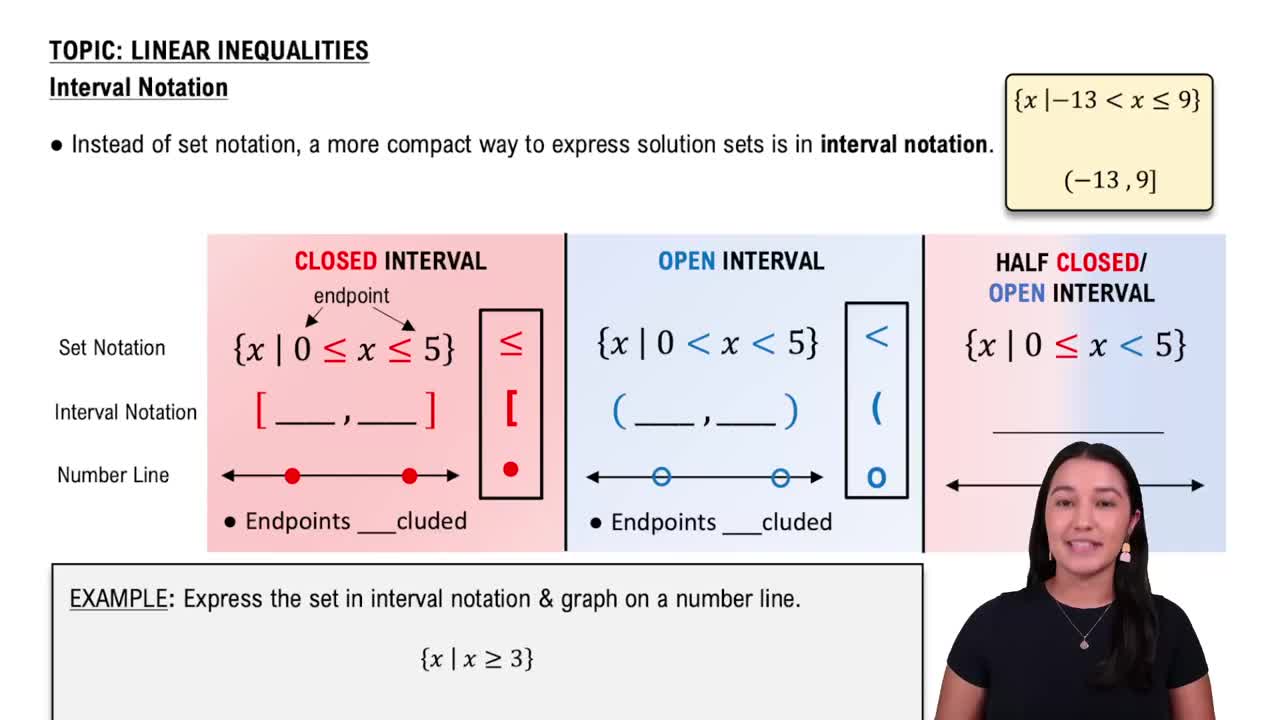
Interval Notation and Graphing Solutions
Interval notation concisely represents sets of real numbers that satisfy the inequality, using parentheses or brackets to indicate whether endpoints are included. Graphing on a number line visually shows these solution intervals and excluded points, aiding interpretation.
Recommended video:
Interval Notation
Related Practice
Textbook Question
530
views
Textbook Question
In Exercises 51–54, graphs of fifth-degree polynomial functions are shown. In each case, specify the number of real zeros and the number of imaginary zeros. Indicate whether there are any real zeros with multiplicity other than 1.
704
views
Textbook Question
Use transformations of f(x)=1/x or f(x)=1/x2 to graph each rational function. g(x)=1/(x+2)2
945
views
Textbook Question
Solve each rational inequality in Exercises 43–60 and graph the solution set on a real number line. Express each solution set in interval notation. (x+4)/x>0
531
views
Textbook Question
Use transformations of f(x)=1/x or f(x)=1/x2 to graph each rational function. h(x)=1/x2 − 4
861
views
Textbook Question
Write an equation in vertex form of the parabola that has the same shape as the graph of f(x) = 2x2 but with the given point as the vertex. (−10, −5)
1031
views