Solve each polynomial inequality in Exercises 1–42 and graph the solution set on a real number line. Express each solution set in interval notation. (x+1)(x−7)≤0
Ch. 3 - Polynomial and Rational Functions

Chapter 4, Problem 4
In Exercises 1–10, determine which functions are polynomial functions. For those that are, identify the degree. g(x)=6x7+πx5+2/3 x
Verified step by step guidance1
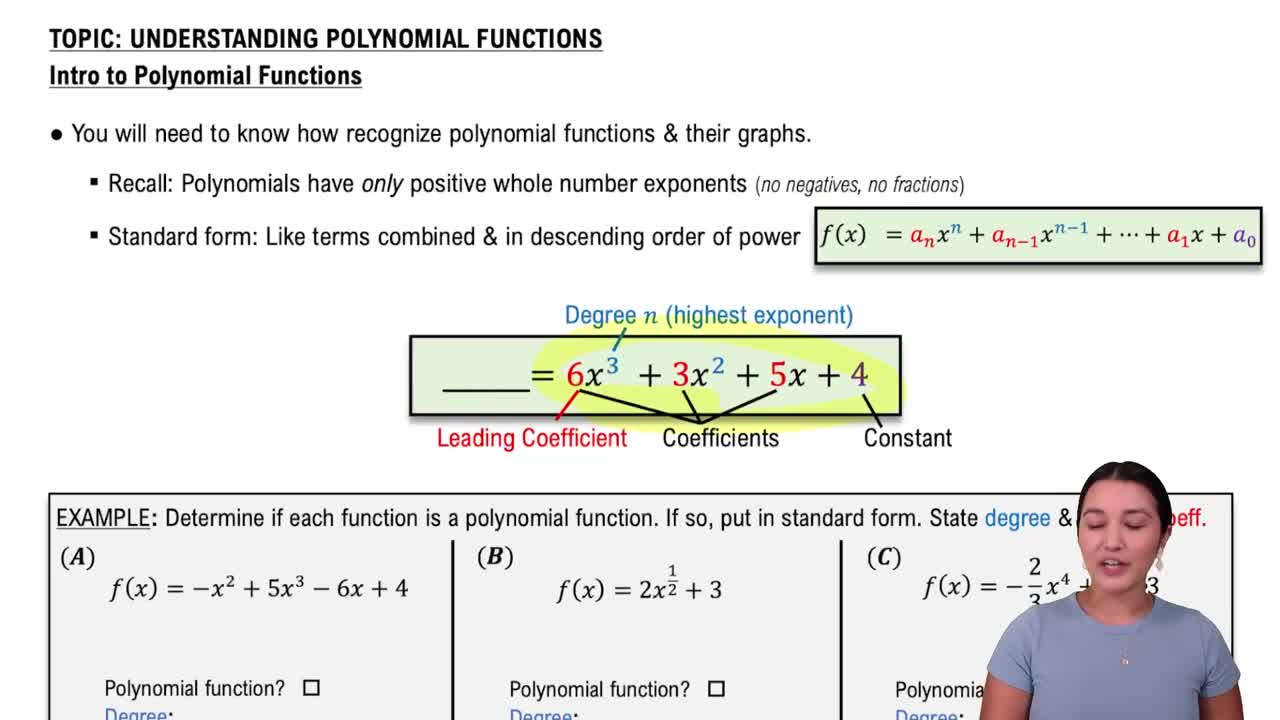
Recall that a polynomial function is a function of the form , where the exponents are whole numbers (non-negative integers) and the coefficients are real numbers.
Examine the given function . Check each term to see if the exponents of are whole numbers and the coefficients are real numbers.
Identify the exponents of in each term: in , in , and in . All are whole numbers.
Confirm that the coefficients , (pi), and are real numbers, which they are.
Since all terms meet the criteria for a polynomial, conclude that is a polynomial function. The degree of the polynomial is the highest exponent of , which is .

Verified video answer for a similar problem:
This video solution was recommended by our tutors as helpful for the problem above.
Video duration:
2mWas this helpful?
Key Concepts
Here are the essential concepts you must grasp in order to answer the question correctly.
Polynomial Functions
A polynomial function is a function that can be expressed as a sum of terms consisting of variables raised to non-negative integer powers, multiplied by coefficients. The coefficients can be any real numbers, including constants like π or fractions. For example, g(x) = 6x^7 + πx^5 + (2/3)x is a polynomial because all exponents are whole numbers and coefficients are real numbers.
Recommended video:
Introduction to Polynomial Functions
Degree of a Polynomial
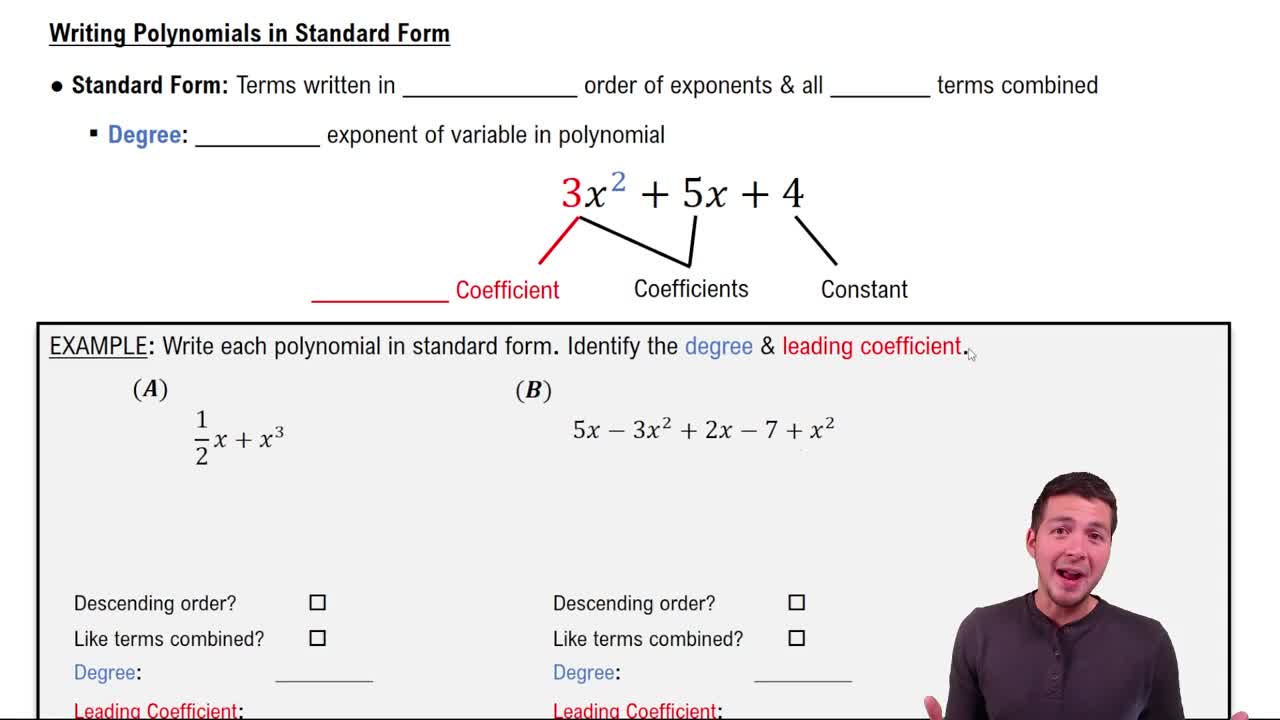
The degree of a polynomial is the highest power of the variable in the expression with a non-zero coefficient. It indicates the polynomial's order and affects its graph's shape and behavior. In g(x) = 6x^7 + πx^5 + (2/3)x, the degree is 7, since the highest exponent of x is 7.
Recommended video:
Guided course
Standard Form of Polynomials
Identifying Non-Polynomial Functions
To determine if a function is not a polynomial, check for variables with negative, fractional, or variable exponents, or variables in denominators, roots, or absolute values. If any such terms exist, the function is not polynomial. Since g(x) has only positive integer exponents and no variables in denominators, it qualifies as a polynomial.
Recommended video:
Introduction to Polynomial Functions
Related Practice
Textbook Question
590
views
Textbook Question
In Exercises 1–4, use the vertex and intercepts to sketch the graph of each quadratic function. Give the equation for the parabola's axis of symmetry. Use the graph to determine the function's domain and range.
1380
views
Textbook Question
The graph of a quadratic function is given. Write the function's equation, selecting from the following options.
2605
views
Textbook Question
Use the Rational Zero Theorem to list all possible rational zeros for each given function. f(x)=3x4−11x3−x2+19x+6
555
views
Textbook Question
Divide using long division. State the quotient, and the remainder, r(x). (x3+5x2+7x+2)÷(x+2)
1148
views
1
rank
Textbook Question
Find the domain of each rational function. h(x)=(x+7)/(x2−49)
1278
views