
Textbook Question
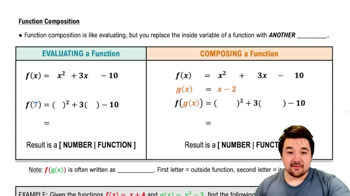
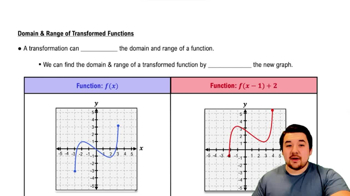
Use the graphs of f and g to evaluate each composite function.
(fog) (-1)
1926
views

 Verified step by step guidance
 4:56
4:56
 4:22
4:22 02:16
02:16Use the graphs of f and g to evaluate each composite function.
(fog) (-1)
In Exercises 77–92, use the graph to determine a. the function's domain; b. the function's range; c. the x-intercepts, if any; d. the y-intercept, if any; and e. the missing function values, indicated by question marks, below each graph.
In Exercises 77–92, use the graph to determine a. the function's domain; b. the function's range; c. the x-intercepts, if any; d. the y-intercept, if any; and e. the missing function values, indicated by question marks, below each graph.
Use the graphs of f and g to evaluate each composite function.
(go f) (0)
The functions in Exercises 93–95 are all one-to-one. For each function, (a) find an equation for f-1(x), the inverse function. (b) Verify that your equation is correct by showing that f(f-1(x)) = x and f-1(f(x)) = x. f(x) = 4x - 3
Let f(x) = x² − x + 4 and g(x) = 3x – 5. Find g (1) and f(g(1)).