Ch. 4 - Exponential and Logarithmic Functions
Blitzer - College Algebra 8th Edition
Blitzer8th EditionCollege AlgebraISBN: 9780136970514Not the one you use?Change textbook
Chapter 5, Problem 66

In Exercises 64–73, solve each exponential equation. Where necessary, express the solution set in terms of natural or common logarithms and use a calculator to obtain a decimal approximation, correct to two decimal places, for the solution. 10^x = 7000

Verified step by step guidance
1
Step 1: Start by isolating the variable x in the equation. The given equation is 10^x = 7000. To solve for x, take the logarithm of both sides of the equation. You can use either the natural logarithm (ln) or the common logarithm (log). Here, we will use the common logarithm since the base of the exponential is 10.
Step 2: Apply the logarithm property log(a^b) = b * log(a) to simplify the left-hand side. Taking the common logarithm of both sides gives log(10^x) = log(7000). Using the property, this simplifies to x * log(10) = log(7000).
Step 3: Recall that log(10) = 1 because the logarithm of 10 with base 10 is 1. Substitute this value into the equation to simplify further: x * 1 = log(7000), which simplifies to x = log(7000).
Step 4: At this point, you can use a calculator to evaluate log(7000) to find the approximate value of x. Ensure that your calculator is set to compute common logarithms (base 10).
Step 5: Once you calculate log(7000), round the result to two decimal places to obtain the final solution for x. The solution set can then be expressed as {x ≈ value}, where 'value' is the rounded result.

Verified video answer for a similar problem:

This video solution was recommended by our tutors as helpful for the problem above.
Video duration:
2m
Was this helpful?

Key Concepts

Here are the essential concepts you must grasp in order to answer the question correctly.

Exponential Equations

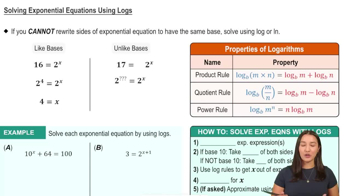
Exponential equations are mathematical expressions in which a variable appears in the exponent. To solve these equations, one typically isolates the exponential term and applies logarithmic functions to both sides. This allows for the conversion of the exponential form into a linear form, making it easier to solve for the variable.
Recommended video:
5:47
Solving Exponential Equations Using Logs

Logarithms

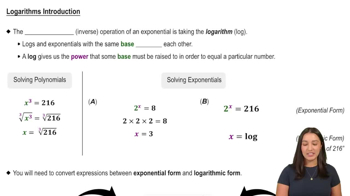
Logarithms are the inverse operations of exponentiation, allowing us to solve for the exponent in an equation. For example, if we have an equation of the form a^b = c, we can express it in logarithmic form as b = log_a(c). In this context, natural logarithms (ln) and common logarithms (log) are often used to simplify calculations and express solutions.
Recommended video:
7:30
Logarithms Introduction

Calculator Use for Approximations

Using a calculator to obtain decimal approximations is essential when dealing with logarithmic solutions that do not yield simple rational numbers. Most scientific calculators can compute logarithms directly, providing a numerical value that can be rounded to a specified number of decimal places, which is particularly useful in practical applications and when presenting final answers.
Recommended video:
5:47
Solving Exponential Equations Using Logs
Related Practice
Textbook Question

The figure shows the graph of f(x) = ln x. In Exercises 65–74, use transformations of this graph to graph each function. Graph and give equations of the asymptotes. Use the graphs to determine each function's domain and range. g(x) = ln (x+2)

826
views
Textbook Question

Use properties of logarithms to condense each logarithmic expression. Write the expression as a single logarithm whose coefficient is 1. Where possible, evaluate logarithmic expressions without using a calculator. 12(log5x+log5y)2log5(x+1)\(\frac{1}{2}\) \(\left\)( \(\log\)_5 x + \(\log\)_5 y \(\right\)) - 2 \(\log\)_5 (x + 1)

970
views
Textbook Question

The figure shows the graph of f(x) = ln x. In Exercises 65–74, use transformations of this graph to graph each function. Graph and give equations of the asymptotes. Use the graphs to determine each function's domain and range.

h(x) = ln (2x)

1360
views
Textbook Question

Solve each logarithmic equation in Exercises 49–92. Be sure to reject any value of xx that is not in the domain of the original logarithmic expressions. Give the exact answer. Then, where necessary, use a calculator to obtain a decimal approximation, correct to two decimal places, for the solution. lnx+3=1\(\ln\]\sqrt{x+3}\)=1

938
views
Textbook Question

Use properties of logarithms to condense each logarithmic expression. Write the expression as a single logarithm whose coefficient is 1. Where possible, evaluate logarithmic expressions without using a calculator. 13[2ln(x+5)lnxln(x24)]\(\frac{1}{3}\) \(\left\)[ 2 \(\ln\)(x + 5) - \(\ln\) x - \(\ln\) (x^2 - 4) \(\right\)]

1002
views
Textbook Question

Solve each logarithmic equation in Exercises 49–92. Be sure to reject any value of x that is not in the domain of the original logarithmic expressions. Give the exact answer. Then, where necessary, use a calculator to obtain a decimal approximation, correct to two decimal places, for the solution. log5 x+log5(4x−1)=1

861
views